
Air fryers have quietly become one of the most relied-on appliances in modern kitchens. From quick breakfasts to late-night snacks, they handle daily cooking with very little oil and very little effort. That convenience is exactly why so many households now depend on them more than traditional ovens.
But here’s the reality most users don’t think about: air fryers don’t last forever.
Like any appliance with a heating element, fan system, and electronic controls, wear and tear is unavoidable. Over time, performance starts to drop—not all at once, but gradually. Food takes longer to cook, textures become inconsistent, and strange issues begin to appear. Many users ignore these early warnings until the air fryer stops working completely.
This is where things get tricky.
Most air fryers last between 2 to 5 years, depending on how often they are used and how well they are maintained. A lightly used unit may last longer, while a daily-use air fryer can start showing issues much sooner. The problem is that many people don’t realize their appliance is already declining—they just assume cooking results are “normal changes.”
In this guide, we’ll break things down in a practical way so you can easily spot when your air fryer is reaching the end of its lifespan. You’ll learn:
- The real air fryer lifespan and what affects it
- The most common signs your air fryer is dying
- When it still makes sense to repair it
- And when replacing it is the smarter, safer option
By the end, you’ll know exactly whether your air fryer still has life left—or if it’s quietly on its last leg.
How Long Do Air Fryers Last?
If you’re wondering whether your air fryer is already “old,” the truth is that most people don’t get a clear answer. Manufacturers rarely give a precise expiration date, and performance decline is usually gradual rather than sudden.
In real-world use, most air fryers last between 2 and 5 years, but that range depends heavily on how you use and care for the appliance.
A lightly used air fryer in a small household might still perform well after 4–5 years. On the other hand, a heavily used unit in a busy kitchen—especially one used daily for fries, chicken, snacks, and reheating—can start showing wear as early as the 2-year mark.
The difference is not just about brand—it’s about stress on the internal components.
What Actually Determines Air Fryer Lifespan?
1. Frequency of Use
This is the biggest factor most people underestimate.
- Occasional use (2–3 times a week): longer lifespan
- Daily use: faster wear on heating element and fan
- Heavy commercial-style use at home: shortest lifespan
Every time you run the air fryer, the heating coil expands and contracts. Over time, this repeated heat cycling slowly reduces efficiency.
2. Quality of Internal Components
Not all air fryers are built the same.
Higher-quality units usually have:
- Stronger heating elements
- Better insulated wiring
- More durable fan motors
- Heat-resistant internal coatings
Cheaper models often work well at first but tend to degrade faster under consistent use.
3. Cleaning Habits
Grease is one of the biggest silent killers of air fryers.
When oil and food particles build up inside:
- Airflow becomes restricted
- Heating becomes uneven
- Smoke and burning smells develop
- Internal parts work harder than necessary
A poorly maintained air fryer can lose years of lifespan simply from neglect.
4. Overloading the Basket
Stuffing too much food into the basket may seem efficient, but it puts pressure on the system.
It causes:
- Poor airflow circulation
- Longer cooking times
- Extra strain on the fan motor
- Uneven heat distribution
Over time, this leads to declining performance and faster breakdown.
5. Electrical Stability
In areas where power supply is unstable, frequent voltage fluctuations can damage:
- Control boards
- Heating systems
- Digital displays
This is one of the most overlooked reasons air fryers “die early.”
So What Is the Realistic Expectation?
Here’s a simple breakdown based on real usage:
- Light use + good care: 4–5 years
- Moderate use: 3–4 years
- Heavy daily use: 2–3 years
- Poor maintenance: can fail under 2 years
So when people ask, “How long do air fryers last?” the honest answer is:
👉 It depends more on habits than the appliance itself.
Why This Matters
Understanding lifespan helps you avoid two common mistakes:
- Replacing an air fryer too early when it could still be fixed
- Or worse, keeping a failing one that is already affecting your food quality and safety
Once you understand the timeline, the warning signs become much easier to spot—which is exactly what we’ll look at next.

7 Signs Your Air Fryer Is Dying
Every air fryer reaches a point where it no longer performs the way it did when it was new. The challenge is that these problems usually develop slowly, making them easy to overlook. You might think your recipes are the issue, or that you’re simply using the wrong cooking settings, when in reality the appliance itself is beginning to fail.
Recognizing these warning signs early can help you avoid undercooked food, unnecessary energy use, and potential safety hazards. Here are the seven most common signs that your air fryer is reaching the end of its lifespan.
1. Your Air Fryer Isn’t Heating Properly
One of the clearest signs of a failing air fryer is when it no longer reaches or maintains the correct cooking temperature. If your food is taking much longer to cook than it used to, or it comes out undercooked even after following the same recipe and settings, there’s a good chance something is wrong with the heating system.
A healthy air fryer should heat up quickly and maintain a consistent temperature throughout the cooking cycle. When this doesn’t happen, cooking results become unpredictable.
Common symptoms include:
- Food remains cold or lukewarm in the center
- Frozen foods stay soggy instead of becoming crispy
- Meat takes much longer than normal to cook
- You constantly have to add extra cooking time
- The appliance feels warm but doesn’t produce enough cooking heat
What causes this problem?
The most common cause of an air fryer not heating properly is a worn or damaged heating element. Over hundreds of cooking cycles, the metal heating coil expands and contracts repeatedly. Eventually, it loses efficiency or fails altogether.
Other possible causes include:
- A faulty thermostat
- Loose internal wiring
- A damaged temperature sensor
- Electrical issues affecting power delivery
Can you fix it?
Before assuming the heating element has failed, try these simple checks:
- Make sure the basket is fully inserted.
- Confirm the outlet is supplying stable power.
- Clean any grease buildup around the heating element.
- Restart the air fryer after letting it cool completely.
If none of these steps improve heating performance, internal components may be failing. On older budget models, replacing the heating element often costs nearly as much as buying a new unit.
Expert Tip: If your air fryer struggles to cook even simple foods like fries or chicken nuggets at the recommended temperature, it’s likely losing heating efficiency and nearing the end of its useful life.
2. Uneven Cooking Results
Air fryers are designed to circulate hot air evenly around your food. When that airflow becomes weak or inconsistent, cooking quality quickly declines.
If you’ve noticed that one side of your food burns while the other side stays pale or undercooked, don’t immediately blame the recipe. The appliance itself may no longer be circulating heat properly.
This is one of the most common reasons people search for “why is my air fryer not cooking evenly?”
Signs of uneven cooking include:
- Fries browned on top but soft underneath
- Chicken cooked on one side only
- Some vegetables burnt while others remain raw
- Needing to flip or shake food much more often than before
- Different results every time you cook
What causes uneven cooking?
Several internal problems can reduce airflow:
A worn-out fan motor
The fan is responsible for moving hot air around the cooking chamber. As the motor ages, it may spin more slowly or inconsistently, reducing cooking performance.
Blocked air vents
Grease and food debris can partially block airflow channels inside the appliance.
Overloaded baskets
Packing too much food into the basket restricts air circulation and forces the appliance to work harder.
How to troubleshoot
Before assuming your air fryer is failing:
- Clean all vents thoroughly.
- Avoid overcrowding the basket.
- Shake food halfway through cooking.
- Check that the fan isn’t making unusual noises.
If the problem continues after cleaning and proper loading, the fan motor may be wearing out.
Expert Tip: Consistent uneven cooking, even with small food batches, is often an early warning that the internal fan is no longer performing efficiently.
3. Strange Noises or Loud Operation
Every air fryer makes some noise while running. The fan circulates hot air continuously, so a gentle humming sound is completely normal.
However, if your air fryer suddenly becomes much louder than it used to, it shouldn’t be ignored.
Unusual sounds are among the most common air fryer issues reported by long-term owners and often indicate mechanical wear inside the appliance.
Warning sounds include:
- Grinding noises
- Loud buzzing
- Rattling during cooking
- Clicking sounds
- High-pitched squealing
- Vibrations stronger than usual
What causes these noises?
The most likely culprit is the fan motor.
As bearings wear down, the fan may become unstable or begin rubbing against nearby components.
Other possible causes include:
- Loose screws or internal brackets
- Bent fan blades
- Worn motor bearings
- Debris caught inside the fan housing
Should you keep using it?
A slight increase in noise isn’t always serious.
But if the sound is getting louder with each use, or you notice reduced cooking performance alongside the noise, it’s usually a sign that internal components are wearing out.
Ignoring mechanical noises can eventually lead to complete fan failure, leaving your air fryer unable to cook food evenly.
Expert Tip: A new grinding or rattling sound that wasn’t there before is worth investigating immediately. Catching the issue early may prevent further damage.
4. Burning Smell or Overheating
It’s normal to notice a slight odor the first few times you use a brand-new air fryer. Manufacturers often coat internal parts with protective oils that burn away during initial use.
However, a persistent burning smell after months or years of ownership is not normal.
If your air fryer smells like burning plastic, hot electrical components, or overheated metal every time you cook—even after a thorough cleaning—it deserves immediate attention.
Possible warning signs include:
- A burning smell that appears during every cooking cycle
- Smoke without food actually burning
- The outside of the appliance becoming unusually hot
- Automatic shutdown due to overheating
- Melted plastic smells
Common causes
Grease buildup
Old grease can burn each time the heating element gets hot.
Food debris touching the heating element
Small crumbs stuck near the heating coil can create smoke and unpleasant odors.
Electrical problems
Damaged insulation or overheating wiring may produce a sharp electrical burning smell.
When is it unsafe?
Stop using your air fryer immediately if:
- You see sparks.
- Smoke comes from areas other than the basket.
- You smell burning electrical insulation.
- The housing becomes dangerously hot to touch.
These symptoms may indicate an internal electrical fault rather than a simple cleaning issue.
Expert Tip: If deep cleaning doesn’t eliminate the smell after one or two cooking cycles, the issue is likely internal rather than surface grease.
5. Air Fryer Keeps Shutting Off
Few things are more frustrating than opening your air fryer to find half-cooked food because the appliance switched itself off halfway through the cooking cycle.
Occasional automatic shutoffs caused by overheating protection can happen, but repeated shutdowns usually signal a deeper problem.
If your air fryer stopped working in the middle of cooking more than once, it’s time to investigate.
You may notice:
- Cooking stops without warning
- The display suddenly turns off
- The appliance restarts after cooling
- Cooking programs cancel unexpectedly
- Power cuts out randomly
Possible causes
Faulty thermostat
The thermostat may incorrectly detect overheating and shut the appliance down prematurely.
Overheating protection activating too often
Blocked airflow or failing internal parts can trigger the safety system repeatedly.
Electrical faults
Loose wiring or failing circuit boards may interrupt power unexpectedly.
Can this be fixed?
Start with simple troubleshooting:
- Clean air vents.
- Avoid placing the appliance against a wall.
- Don’t overload the basket.
- Allow the air fryer to cool completely between long cooking sessions.
If the issue continues despite proper use, the thermostat or electronics may need replacement.
Expert Tip: Random shutdowns combined with heating problems often indicate that several internal components are wearing out at the same time.
6. Buttons or Display Stop Responding
Modern digital air fryers rely on electronic control panels to manage cooking time, temperature, and preset programs.
When those controls begin failing, using the appliance becomes frustrating and unreliable.
Common symptoms include:
- Buttons only work after several presses
- Touch controls stop responding
- The display flickers or goes blank
- Temperature changes by itself
- Timer resets unexpectedly
What causes control panel failure?
Over time, repeated exposure to heat and steam can affect sensitive electronic components.
Possible causes include:
- Moisture entering the control panel
- Worn touch sensors
- Damaged circuit board
- Loose internal connections
Unlike baskets or trays, digital control boards are usually expensive to replace.
Should you repair it?
If your air fryer is still under warranty, repairing the control panel may be worthwhile.
However, for older appliances, replacing the entire unit is often the more cost-effective option.
Expert Tip: If the display starts behaving unpredictably alongside other performance issues, it’s often a sign that the appliance is nearing the end of its service life.
7. Basket or Coating Is Peeling Badly
While internal electronics usually receive the most attention, the cooking basket also has a limited lifespan.
Over time, the non-stick coating can wear away from repeated use, high temperatures, and improper cleaning.
Minor scratches are common, but extensive peeling is a different story.
Warning signs include:
- Large areas of missing coating
- Food sticking badly during cooking
- Rust appearing on exposed metal
- Flakes of coating coming off while washing
- Deep scratches exposing bare metal
Why this matters
A damaged basket affects more than appearance.
It can:
- Reduce cooking performance
- Make cleanup more difficult
- Cause food to stick and burn
- Shorten cooking basket life
- Affect the overall cooking experience
Using metal utensils or abrasive scrubbers speeds up coating wear significantly.
Can you replace just the basket?
In many cases, yes.
Replacement baskets are available for popular air fryer models and can extend the life of an otherwise healthy appliance.
However, if the basket is badly worn and the air fryer is also experiencing heating, fan, or electrical issues, investing in a completely new model usually offers better long-term value.
Expert Tip: To protect your basket and extend its lifespan, wash it with a soft sponge, avoid metal utensils, and clean it after every use to prevent baked-on grease from damaging the non-stick coating.
Repair or Replace? What Makes More Sense
Once your air fryer starts showing signs of failure, the next question is usually not “is it broken?” but rather “should I fix it or just buy a new one?”
The answer depends on three things: age, type of problem, and repair cost.
In many cases, people spend money trying to repair an appliance that is already near the end of its natural lifespan. But sometimes, a simple fix can still extend its life for a while.
Let’s break it down clearly.
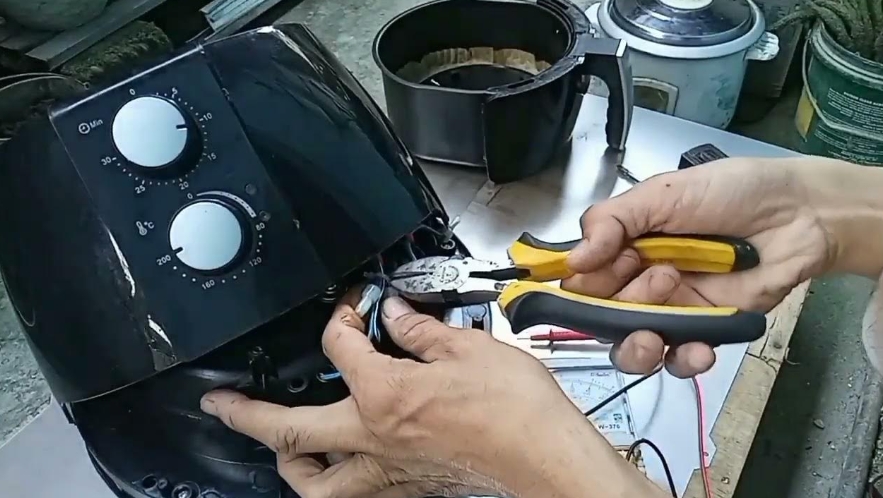
When Repairing Your Air Fryer Makes Sense
Repair is worth considering only in specific situations:
✔ Minor or surface-level issues
- Loose basket handle
- Slight wiring or plug issues
- Dirty or clogged heating chamber
- Small fan obstructions
These problems are usually cheap or easy to fix, especially if the unit is still relatively new.
✔ The air fryer is still fairly new (under 2 years)
If your air fryer is still within its early lifespan and:
- It has been lightly used
- The issue is isolated
- Performance was previously strong
Then repair can extend its usefulness without wasting your investment.
✔ It’s a high-end or expensive model
Premium air fryers often have:
- Better replacement parts availability
- Stronger build quality
- Longer potential lifespan after repair
In this case, repair can be more cost-effective than replacement.
When You Should Replace Your Air Fryer
In many real-world situations, replacement is the smarter choice.
Heating system failure
If the air fryer no longer heats properly, repair costs are often high—and not always reliable long-term.
Multiple issues at the same time
If you’re dealing with:
- Weak heating
- Strange noises
- Display problems
- Uneven cooking
It usually means the appliance is in overall decline, not just one faulty part.
Older unit (3–5 years or more)
Even if repairs are possible, older air fryers often:
- Break down again shortly after fixing
- Have outdated or worn-out components
- Cost more to maintain over time
At this stage, replacement is usually more practical.
🛑 Repair cost is too high
A simple rule many technicians follow:
👉 If repair costs exceed 40–50% of a new air fryer, replacement is the better option.
You’re essentially paying close to a new unit for an old one with limited remaining lifespan.
The Smart Way to Decide
If you’re unsure, ask yourself these questions:
- Is this the first major issue, or are problems stacking up?
- Has performance been declining for a while?
- Is the repair cost worth the remaining lifespan?
- Would I trust this appliance for daily cooking after repair?
If the honest answer leans toward “no,” replacement is the more reliable path.
Practical Reality Check
Many users hold on to failing air fryers because they still “kind of work.” But in reality, declining performance means:
- Longer cooking times
- Less consistent results
- Higher frustration in daily use
- Increased risk of sudden failure
At a certain point, the cost of inconvenience is higher than the cost of replacing it.
How to Extend Your Air Fryer Lifespan
Most air fryers don’t “just die” early on their own. In many cases, they wear out faster because of everyday habits that slowly strain the internal parts.
The good news is that with the right care, you can often push your air fryer beyond the average lifespan and keep it performing consistently for years.
Here’s how to get the most out of it.
1. Clean It After Every Use (Not Occasionally)
This is the single most important habit.
Grease, crumbs, and oil residue build up quickly inside the basket and heating area. If left uncleaned, they can:
- Block airflow
- Cause smoking and burning smells
- Force the heating element to work harder
- Lead to uneven cooking
A quick wipe after each use and a proper wash of the basket goes a long way in protecting the internal system.
Think of it this way: a clean air fryer runs cooler, smoother, and lasts longer.
2. Avoid Overloading the Basket
It’s tempting to cook everything in one batch, especially when you’re in a hurry. But overloading is one of the fastest ways to reduce performance.
When the basket is packed too tightly:
- Hot air cannot circulate properly
- Food cooks unevenly
- The fan and heating system are forced to work harder
Over time, this extra strain reduces efficiency and shortens lifespan.
A better approach is cooking in smaller batches for more consistent results.
3. Don’t Ignore Preheating When Needed
Some air fryers perform better when preheated, especially for meats and frozen foods.
Skipping preheating can:
- Increase cooking time
- Cause uneven results
- Put unnecessary strain on heating cycles
Even a 2–3 minute preheat can improve efficiency and reduce stress on the appliance.
4. Use the Right Temperature Settings
Running your air fryer at maximum temperature constantly may seem faster, but it increases wear over time.
High heat settings:
- Stress the heating element
- Reduce long-term stability
- Increase chances of overheating issues
Whenever possible, use moderate temperatures and adjust cooking time instead of pushing extreme heat.
5. Protect the Non-Stick Surface
The basket coating is more important than most people realize.
To protect it:
- Avoid metal utensils
- Don’t scrape hard residue aggressively
- Use silicone or wooden tools instead
Once the coating starts peeling or scratching badly, performance and food quality both suffer.
6. Allow Proper Cooling Between Uses
Using the air fryer back-to-back without rest can cause internal overheating.
Always:
- Let it cool for a few minutes before cleaning
- Avoid immediately restarting multiple cycles
- Ensure airflow vents are not blocked
This helps protect both the fan system and internal electronics.
7. Keep It in a Stable Electrical Environment
Power fluctuations are a silent killer of small appliances.
If possible:
- Use a surge protector
- Avoid shared overloaded sockets
- Keep it away from unstable power sources
This helps protect the control board and extends overall lifespan significantly.
What These Habits Actually Do
When combined, these practices:
- Reduce internal stress
- Improve airflow efficiency
- Prevent overheating
- Maintain consistent cooking performance
In simple terms, they help your air fryer stay “new-like” for longer instead of slowly degrading.
Small Effort, Big Difference
The difference between a 2-year air fryer and a 5-year air fryer often isn’t the brand—it’s the care it receives.
Most people only start paying attention when problems appear. But by then, wear and tear has already built up.
A few small habits early on can easily add extra years of reliable use.
Common Air Fryer Problems and Quick Fixes
Before assuming your air fryer is dying, it’s worth checking a few common issues. Many performance problems are not permanent failures—they’re often caused by maintenance issues, usage habits, or simple blockages.
Below are the most frequent air fryer problems and what you can do about them.

1. Air Fryer Not Turning On
This is usually the first panic moment for most users.
Possible causes:
- Power cable not properly connected
- Faulty wall socket
- Loose internal connection
- Tripped fuse or safety switch
Quick fixes:
- Plug it into a different socket
- Check if the power cable is fully inserted
- Reset the appliance (if your model has a reset function)
- Try another appliance in the same socket to confirm power flow
If it still doesn’t turn on after these steps, the issue may be internal and more serious.
2. Air Fryer Not Heating Properly
When food comes out undercooked or takes too long, heating is usually the issue.
Possible causes:
- Grease buildup blocking heat circulation
- Weak heating element
- Incorrect temperature setting
- Overloaded basket
Quick fixes:
- Deep clean the heating chamber and basket
- Avoid overcrowding food
- Increase preheating time
- Test different temperature settings
If heating is still weak after cleaning, the heating element may be wearing out.
3. Smoke Coming Out During Cooking
A little smoke occasionally is normal, but frequent smoke is not.
Possible causes:
- Excess oil or grease buildup
- Food residue burning inside
- High-fat foods dripping into heating area
Quick fixes:
- Clean the basket and interior thoroughly
- Use less oil during cooking
- Place a small bit of water in the drawer (for fatty foods)
- Clean after every greasy meal
Persistent smoke even after cleaning may indicate internal overheating issues.
4. Air Fryer Smells Like It’s Burning
This is different from normal cooking smells.
Possible causes:
- Old grease burning inside
- Electrical components overheating
- Dust accumulation near heating element
Quick fixes:
- Perform a deep clean of all removable parts
- Run a “blank cycle” at low temperature for a few minutes after cleaning
- Ensure vents are not blocked
If the smell continues even when clean, it may be a warning of internal damage.
5. Food Cooking Unevenly
Uneven cooking is one of the most frustrating issues.
Possible causes:
- Overloaded basket
- Weak fan circulation
- Food not shaken or turned during cooking
Quick fixes:
- Reduce portion size per batch
- Shake or flip food halfway through cooking
- Make sure air vents are not blocked
If uneven cooking continues even with proper usage, airflow may be weakening.
6. Air Fryer Stops Mid-Cooking
Sudden shutdowns are often misunderstood as full failure.
Possible causes:
- Overheating protection system activated
- Faulty thermostat
- Power instability
Quick fixes:
- Let the air fryer cool down before restarting
- Avoid running back-to-back cycles
- Check for proper ventilation around the unit
If shutdowns become frequent, internal components may be failing.
7. Buttons or Display Not Responding
Modern air fryers rely heavily on digital controls, so this issue can be frustrating.
Possible causes:
- Moisture or grease on control panel
- Software glitch
- Failing control board
Quick fixes:
- Wipe the panel gently with a dry cloth
- Unplug and restart the unit
- Avoid pressing buttons with wet hands
If the display keeps freezing or lagging, the control board may need replacement.
When These “Fixes” Don’t Work
If you’ve tried multiple solutions and the problems keep returning, it usually means:
- The appliance is aging
- Multiple internal components are weakening
- Repair may not be cost-effective anymore
At that point, it’s no longer a small issue—it’s a sign of overall decline.
Key Takeaway
Many air fryer problems can be solved with simple cleaning or usage adjustments. But when issues start repeating or stacking up, it becomes a sign that the appliance is moving toward the end of its lifespan.
FAQs
How long does an air fryer last with daily use?
Typically 2–3 years with heavy daily cooking before performance drops.
Is it worth repairing an air fryer?
Only if it’s a minor issue or a high-quality model still within early years of use.
What causes an air fryer to stop working?
Common causes include heating failure, fan motor damage, and control board issues.
When should I replace my air fryer?
When multiple problems appear or cooking performance becomes inconsistent and unreliable.
Conclusion
Air fryers are designed to make cooking faster, easier, and more consistent—but like every kitchen appliance, they eventually wear out. The important thing is not just how long they last, but how early you can recognize the warning signs before performance drops completely.
Most air fryers will serve you well for about 2 to 5 years, but that lifespan depends heavily on usage habits, cleaning routine, and how much stress the appliance goes through during daily cooking. Once you start noticing issues like weak heating, uneven cooking, strange noises, or frequent shutdowns, your air fryer is usually already in its decline phase.
The key takeaway is simple: don’t ignore gradual performance changes.
A slightly longer cooking time or minor inconsistency may not seem like a big deal at first, but these are often early indicators that internal components are wearing out. Waiting too long can lead to sudden failure right when you need it most.
If your air fryer is still under 2 years old, many issues can often be managed with proper cleaning and better usage habits. But if it’s older and showing multiple warning signs at once, replacing it is usually the more practical and reliable option.
At the end of the day, a healthy air fryer should make cooking easier—not more frustrating. When it stops doing that, it’s often a sign that it’s time for an upgrade.