
Choosing between an air fryer vs Instant Pot can be surprisingly difficult, especially if you are trying to reduce the number of appliances on your kitchen counter. Both appliances are popular for making home cooking faster and more convenient, but they are not designed to do exactly the same things. One is particularly good at creating crispy, browned food, while the other is designed to cook foods under pressure and produce tender, flavorful meals.
The confusion usually starts because both appliances are marketed as versatile kitchen tools. An air fryer can roast, bake, reheat, and sometimes dehydrate, while an Instant Pot can pressure cook, slow cook, steam, sauté, and perform other functions depending on the model. Looking at the number of functions alone, it can be difficult to tell which one would actually be more useful in your kitchen.
The better way to compare them is to look at how you cook and what you eat most often. If your regular meals include French fries, chicken wings, frozen snacks, roasted vegetables, fish, and crispy leftovers, an air fryer could become one of the most useful appliances you own. On the other hand, if you frequently prepare beans, rice, soups, stews, shredded meat, or large one-pot meals, an Instant Pot may be a better match.
There is also an important difference in the texture each appliance produces. Air frying uses rapidly circulating hot air to remove moisture from the surface of food and encourage browning. That is what gives fries and chicken wings their crisp exterior. An Instant Pot relies on steam and pressure, which is excellent for breaking down tougher ingredients and keeping food moist, but it does not naturally create the same crispy finish.
That is why this comparison is less about finding an overall winner and more about finding the right appliance for your cooking style. In this guide, we will look closely at the differences between an air fryer and an Instant Pot, what each one does best, cooking times, energy use, ease of use, food capacity, pros and cons, and whether buying both actually makes sense.
Air Fryer vs Instant Pot: What’s the Difference?
The biggest difference between an air fryer and an Instant Pot is the cooking method each appliance uses. Although both are electric countertop appliances, they create very different cooking environments.
An air fryer uses a heating element and a fan to circulate very hot air around the food. This is a form of dry-heat cooking. The hot air moves continuously around the food, helping moisture escape from the surface while the exterior browns and becomes crisp. This makes an air fryer especially useful for foods where texture matters just as much as doneness.
An Instant Pot works in almost the opposite way. It uses liquid to create steam inside a sealed cooking chamber. As steam builds up, pressure increases, allowing the food to cook at a higher temperature than it would under normal atmospheric pressure. This is particularly useful for ingredients that need time to soften, such as dried beans, tough cuts of meat, lentils, and certain grains.
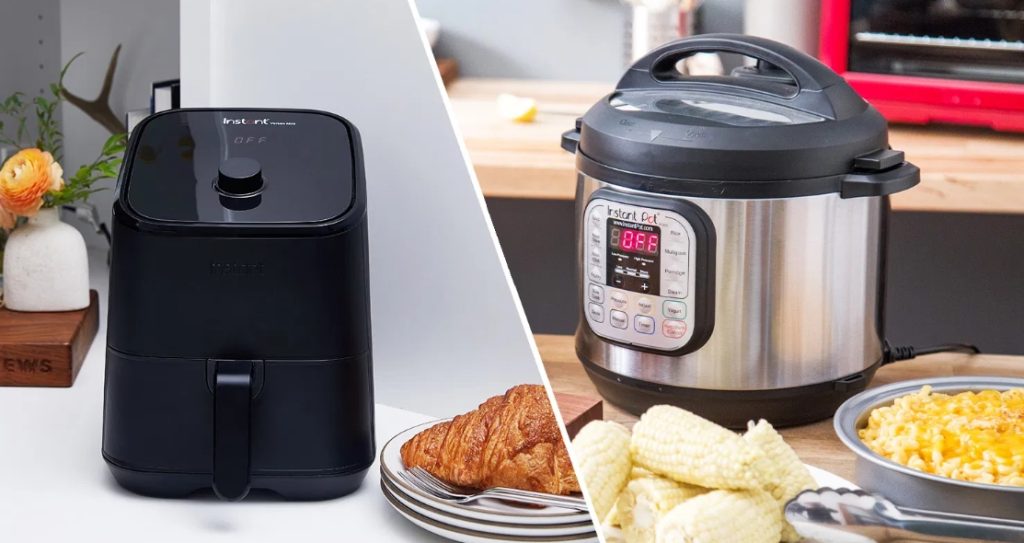
Air Fryer = Dry Heat and Crisping
Think of an air fryer as a small, powerful convection oven with a cooking chamber designed to move hot air efficiently around food.
For example, if you place frozen French fries in an air fryer, the circulating heat helps remove surface moisture while browning the outside. The result can be crisp on the outside and soft inside without the large amount of oil required for traditional deep frying.
The same principle works well with chicken wings. The hot air helps render some of the fat from the skin while encouraging browning. This is one reason air fryers have become so popular with people who want crispy chicken without using a deep fryer.
Air fryers are also useful for reheating foods. Pizza, fried chicken, roasted potatoes, and other leftovers can often be reheated with a better texture than they would have in a microwave. Instead of simply warming the food, the dry heat can help restore some of its original crispness.
Instant Pot = Pressure, Steam and Tender Cooking
An Instant Pot is better thought of as a pressure cooker with multiple cooking functions.
When you add liquid and seal the lid, the appliance heats the liquid until it produces steam. Because the steam is trapped inside the sealed pot, pressure builds. This raises the cooking temperature and allows certain foods to cook much faster than they would through conventional simmering.
This is particularly useful when preparing foods that normally take a long time to become tender.
For example, dried beans can take a considerable amount of time to cook on the stovetop, especially if they have not been soaked. Pressure cooking can make the process much more convenient. Tough cuts of beef or pork can also become tender because the combination of heat, pressure, and moisture helps break down connective tissue.
The Instant Pot is also well suited to soups and stews because these foods naturally require liquid. You can add meat, vegetables, broth, seasonings, and other ingredients to the pot, select the appropriate cooking setting, and allow the appliance to handle much of the cooking process.
Why These Differences Matter
The difference becomes much clearer when you imagine two meals.
Suppose you want crispy chicken wings with roasted potatoes. An air fryer is an obvious choice because both foods benefit from dry heat and browning.
Now imagine you want beef stew with tender meat, carrots, potatoes, and a rich broth. An Instant Pot makes much more sense because pressure cooking is suited to this type of meal.
Neither appliance is failing at the other’s job. They are simply designed around different cooking principles.
That is why searching for the best appliance between an Air Fryer or Instant Pot without considering your cooking habits can lead to the wrong purchase.
What Is an Air Fryer?
An air fryer is a countertop cooking appliance that uses a heating element and fan to circulate hot air rapidly around food. While the name suggests frying, there is no deep bath of cooking oil involved. Instead, the appliance uses moving hot air to create browning and a crisp outer texture.
Most air fryers have a removable basket or cooking tray that allows hot air to reach the food from different directions. Some larger models are designed like small ovens and include multiple racks, trays, or accessories.
The exact design varies between models, but the basic principle remains the same: hot air moves quickly around the food while the heating element maintains the cooking temperature.
This makes an air fryer particularly useful for foods that would normally be deep-fried, roasted, baked, or reheated.
What Can You Cook in an Air Fryer?
The list is surprisingly long.
Common examples include:
- French fries
- Chicken wings
- Chicken thighs
- Chicken tenders
- Fish fillets
- Burgers
- Sausages
- Frozen snacks
- Hash browns
- Potato wedges
- Roasted vegetables
- Toasted sandwiches
- Reheated pizza
- Small baked goods
However, an air fryer is not equally good at everything.
It excels when you want browning, crisping, roasting, or fast reheating. It is less suitable for foods that require a large amount of liquid or a sealed, moist cooking environment.
For instance, you would not choose a traditional air fryer to cook a pot of bean soup. The appliance simply is not designed for that type of cooking.
Why Do Air Fryers Cook So Quickly?
One reason air fryers are convenient is that they have a relatively small cooking chamber compared with a full-size oven. You are not heating a large oven cavity when preparing a small portion of food.
The fan also keeps hot air moving around the food. This continuous circulation helps transfer heat efficiently to the food’s surface.
Consider reheating two slices of pizza. Turning on a full-size oven just for two slices can feel unnecessary because you are heating a much larger space than you actually need. An air fryer can handle that smaller task with much less setup.
Cooking time still varies according to the food, its thickness, the quantity in the basket, and the particular air fryer. A crowded basket can also slow cooking and reduce crispness because the hot air cannot circulate freely.
Does an Air Fryer Really Need Oil?
Not always.
Many foods contain enough natural fat to brown and crisp without additional oil. Frozen fries, for example, often already contain some oil from their manufacturing process.
For fresh potatoes or vegetables, a small amount of oil can improve browning and texture, but you generally do not need the quantity used for traditional deep frying.
This is one of the practical advantages of air frying. You can enjoy foods with a fried-style texture while using much less oil than deep-frying would normally require.
However, less oil does not automatically make every air-fried meal healthy. The ingredients themselves still matter. Air-frying heavily processed foods does not turn them into nutritious foods simply because they were cooked with less oil.
What Is an Instant Pot?
An Instant Pot is an electric multi-cooker best known for pressure cooking. Unlike an air fryer, it does not rely on circulating dry air to create a crispy surface. Instead, it uses heat, liquid, steam, and pressure to cook food efficiently.
The pressure-cooking function is the feature that makes the appliance particularly useful for foods that normally take a long time to become tender.
Depending on the model, an Instant Pot can also provide several other cooking functions. These may include slow cooking, sautéing, steaming, rice cooking, yogurt making, and keeping food warm.
However, the exact features differ from one model to another, so it is always worth checking the specifications of the particular Instant Pot you are considering.
Why Is Pressure Cooking Useful?
Pressure cooking is particularly valuable when you are dealing with ingredients that need time to soften.
Imagine making a beef stew on the stovetop. You might need to simmer the meat for a long period before it becomes tender. With pressure cooking, the sealed environment allows the food to cook at a higher temperature, helping reduce the time needed for many such dishes.
The same advantage applies to foods such as dried beans and lentils.
This makes the Instant Pot popular with people who like preparing hearty meals but do not want to spend hours watching a pot on the stove.
What Can You Cook in an Instant Pot?
An Instant Pot can be useful for:
- Rice
- Dried beans
- Lentils
- Soups
- Stews
- Chili
- Pulled pork
- Shredded chicken
- Tough cuts of beef
- Vegetables
- Grains
- Some steamed foods
It is particularly good at meals where moisture is part of the recipe.
For example, if you want to make a pot of chili, you can sauté ingredients first, add the remaining ingredients, seal the pot, and pressure cook the meal. That reduces the number of pots and pans needed and can make meal preparation more convenient.
What About the Instant Pot Cooking Time?
One mistake beginners sometimes make is looking only at the cooking time shown on the display.
If a recipe says to pressure cook something for 20 minutes, that does not necessarily mean the entire process will take exactly 20 minutes.
The Instant Pot first needs time to build pressure. Depending on the amount of food and liquid inside, this can take several minutes.
After cooking, you may also need to release the pressure. A natural release can take additional time, while a quick release is faster but must be handled according to the appliance’s instructions.
Therefore, when comparing Air Fryer vs Instant Pot cooking time, always consider the complete process.
For some foods, the Instant Pot can still be much faster than traditional cooking. The important point is that its displayed cooking time is only one part of the overall process.
Air Fryer vs Instant Pot Comparison at a Glance
Now that we have covered how each appliance works, it becomes easier to understand why an Air Fryer vs Instant Pot comparison is not as simple as choosing the appliance with the most functions.
The two appliances are built around different cooking methods. An air fryer is mainly designed to expose food to circulating dry heat, which makes it excellent for browning and crisping. An Instant Pot uses pressure and steam, making it better for foods that need moisture and longer cooking to become tender.
The table below gives you a quick overview before we look at each category in more detail.
| Feature | Air Fryer | Instant Pot |
|---|---|---|
| Main cooking method | Rapid hot-air circulation | Pressure and steam |
| Best for | Crispy and browned foods | Tender and moist foods |
| Frozen foods | Excellent | Usually not ideal |
| Reheating | Excellent | Limited |
| Chicken wings | Excellent | Not ideal for crisping |
| Rice | Not designed for it | Excellent |
| Dried beans | Not suitable | Excellent |
| Soups | Not suitable | Excellent |
| Stews | Limited | Excellent |
| Roasted vegetables | Excellent | Good, but softer |
| Crisping | Excellent | Limited |
| Pressure cooking | No | Yes |
| Ease of use | Generally simple | Requires more learning |
| One-pot meals | Limited | Excellent |
| Added oil | Little or none for many foods | Usually little |
| Main strength | Speed and crisping | Pressure cooking and meal versatility |
This comparison should give you a general idea, but real-world cooking is where the differences become more useful. The best way to decide between an Air Fryer or Instant Pot is to look at the foods you actually prepare.
Air Fryer vs Instant Pot for Different Foods
The type of food you cook most often should have a major influence on your decision. An appliance may have many impressive features, but those features do not provide much value if they do not match your normal meals.
For example, someone who regularly makes chicken wings, fries, roasted vegetables, and frozen snacks may get much more use from an air fryer than an Instant Pot. Someone who prepares beans, rice, soups, stews, and shredded meat may have the opposite experience.
Let’s look at some of the most common foods individually.
Air Fryer vs Instant Pot for Chicken
Chicken is one of the foods where the difference between the two appliances becomes very obvious.
An air fryer is excellent when you want crispy chicken. The circulating hot air exposes the surface of the chicken to dry heat, helping the skin brown and become crisp while the inside cooks.
Chicken wings are a particularly good example. Instead of deep-frying them in several cups of oil, you can place them in an air fryer and allow the hot air to circulate around them. When the basket is not overcrowded and the chicken is cooked properly, the result can be nicely browned skin with a juicy interior.
Chicken thighs and drumsticks can also work very well in an air fryer. A light coating of oil and seasoning is often enough to produce a flavorful, browned exterior.
However, the Instant Pot has a different advantage.
Pressure cooking is excellent for making tender chicken. It can be especially useful when you want shredded chicken for sandwiches, tacos, wraps, salads, soups, or meal preparation.
For example, you can pressure-cook chicken breasts with broth and seasonings until tender, then shred the meat with forks. This is much more suited to the Instant Pot than trying to create crispy skin.
Which Is Better for Chicken?
It depends on the result you want.
Choose an air fryer for:
- Crispy chicken wings
- Crispy chicken thighs
- Chicken tenders
- Breaded chicken
- Roasted chicken pieces
Choose an Instant Pot for:
- Shredded chicken
- Chicken soup
- Chicken for meal prep
- Tender chicken for tacos and sandwiches
- Chicken dishes with broth or sauce
If you want both tenderness and crispiness, there is also an interesting option: use both appliances.
You could pressure-cook chicken in the Instant Pot first to make it tender and then transfer it to an air fryer to brown and crisp the outside.
That is a good example of how these appliances can complement one another rather than compete.
Air Fryer vs Instant Pot for Beef
Beef is another category where the cooking method matters more than the appliance itself.
An air fryer can be useful for smaller cuts of beef. Depending on the model and recipe, you can prepare burgers, meatballs, steak, beef strips, and other relatively small portions.
The dry heat helps brown the exterior, which is useful when you want a roasted or grilled-style surface.
However, an air fryer is not the best choice for every beef dish.
Tough cuts of beef often benefit from long, moist cooking. This is where an Instant Pot becomes more useful.
Pressure cooking can help break down connective tissue in tougher cuts, producing tender meat for stews, shredded beef, and other dishes.
For example, a tough piece of beef that would normally require several hours of slow cooking can be prepared much more quickly under pressure.
Which Is Better for Beef?
Air fryer: Better when you want browning and a relatively quick dry-heat cooking method.
Instant Pot: Better when you want tender meat, stews, shredded beef, or dishes containing broth or sauce.
So, if your favorite beef meal is steak or meatballs, an air fryer may get more use. If you regularly make beef stew or shredded beef, the Instant Pot has the advantage.
Air Fryer vs Instant Pot for Vegetables
Both appliances can cook vegetables, but they produce very different results.
An air fryer is particularly good at creating roasted vegetables with browned edges.
Vegetables such as broccoli, cauliflower, Brussels sprouts, carrots, zucchini, and potatoes can develop a slightly crisp exterior while remaining tender inside.
For example, tossing broccoli florets with a small amount of oil and seasoning before air frying can produce browned edges and a roasted flavor that is difficult to reproduce with pressure cooking.
The Instant Pot can cook vegetables extremely quickly, but pressure and steam generally produce a softer result.
This can be useful if you prefer soft vegetables or are adding vegetables to soups and stews. However, it is not the best method when your goal is crisp edges.
Which Is Better for Vegetables?
If you want roasted, browned, or slightly crispy vegetables, choose the air fryer.
If you want soft vegetables for soups, stews, or other moist dishes, an Instant Pot can be more useful.
This is a good example of why cooking method matters more than simply asking which appliance is more versatile.
Air Fryer vs Instant Pot for Rice
When it comes to rice, the Instant Pot is the clear winner.
Rice requires controlled moisture to cook properly, and the Instant Pot is designed around this type of cooking.
You add the appropriate amount of liquid and rice, select the appropriate cooking setting, and allow the appliance to handle the cooking process.
An air fryer, by comparison, is not designed to boil or pressure-cook rice.
There are recipes that use an oven-style air fryer to prepare certain rice dishes, but this is not the appliance’s main strength and usually requires a suitable oven-safe container and a specific recipe.
If rice is a regular part of your meals, an Instant Pot makes much more sense.
Best Choice for Rice
Instant Pot.
Its ability to cook rice and other grains is one of the reasons it can be so useful for households that prepare these foods frequently.
Air Fryer vs Instant Pot for Beans
Beans are another category where the Instant Pot has a major advantage.
Dried beans normally require a long cooking process because they need enough time and moisture to soften.
An Instant Pot’s pressure-cooking environment is particularly useful here. It allows the beans to cook at a higher temperature while surrounded by steam and liquid.
This can make preparing dried beans much more convenient.
An air fryer is simply not designed for this type of cooking. It uses dry circulating heat rather than the liquid-based environment required to soften dried beans properly.
Best Choice for Beans
Instant Pot.
If you regularly cook dried beans, lentils, or similar ingredients, pressure cooking can save you considerable time compared with conventional stovetop preparation.
Air Fryer vs Instant Pot for Frozen Foods
This is one of the strongest categories for an air fryer.
Frozen foods are often designed to become crisp on the outside while remaining soft inside, which is exactly where air frying performs well.
You can commonly prepare foods such as:
- Frozen French fries
- Chicken nuggets
- Fish sticks
- Hash browns
- Frozen vegetables
- Mozzarella sticks
- Potato wedges
- Breaded chicken
- Frozen snacks
One of the biggest advantages is convenience. Many frozen foods can go directly into the air fryer without thawing.
The circulating hot air helps remove moisture from the surface while browning the food.
An Instant Pot can cook certain frozen ingredients, but it is generally not the best choice when your goal is crispiness.
For example, you might be able to pressure-cook frozen chicken, but the resulting texture will not be the same as chicken cooked in an air fryer.
Best Choice for Frozen Foods
Air fryer.
If frozen foods are a regular part of your cooking routine, this alone may be enough reason to choose an air fryer.
Air Fryer vs Instant Pot for Soups and Stews
This is one of the easiest categories to decide.
The Instant Pot is designed for moist cooking, making it naturally suited to soups and stews.
You can combine ingredients such as meat, vegetables, beans, broth, tomatoes, and seasonings in the cooking pot. Pressure cooking can then help develop tender textures without requiring hours of simmering.
For example, a beef stew containing a tougher cut of meat can benefit from pressure cooking because the moist, pressurized environment helps tenderize the meat.
An air fryer does not provide the same cooking environment.
While an air fryer can roast some of the ingredients before they are added to a soup or stew, it is not a replacement for the pot used to cook the complete dish.
Best Choice for Soups and Stews
Instant Pot.
If soups, chili, stews, and other one-pot meals are common in your home, the Instant Pot is likely to be much more useful.
Air Fryer vs Instant Pot for Reheating Leftovers
Reheating is an area where an air fryer often has a major advantage.
A microwave is excellent for speed, but foods that were originally crispy can become soft when reheated with microwave energy.
An air fryer uses dry heat instead.
For example, leftover pizza can develop a crispier crust when reheated in an air fryer. Fried chicken can also regain some of its exterior texture, while roasted potatoes can become crisp again.
An Instant Pot is generally not the first appliance you would choose for this job.
Because it uses moisture and steam during pressure cooking, it does not naturally recreate the dry, crispy texture that many leftovers need.
Best Choice for Reheating
Air fryer.
This is particularly useful for people who frequently cook larger meals and reheat portions later.
Which Appliance Is More Versatile?
The answer depends on how you define versatility.
An Instant Pot may appear more versatile because many models combine several cooking functions in one appliance. Depending on the model, you may get pressure cooking, slow cooking, sautéing, steaming, rice cooking, warming, and other programs.
An air fryer can also perform several cooking tasks. Depending on the model, these may include air frying, roasting, baking, reheating, and dehydrating.
However, the number of functions on the control panel should not be the only factor you consider.
Imagine an air fryer has six cooking functions but you mainly want crispy chicken and fries. Those six functions may be more useful to you than an Instant Pot with ten functions you rarely use.
The reverse is also true. If you regularly make beans, rice, soups, stews, and shredded meat, the Instant Pot’s pressure-cooking function could be far more valuable than several air-fryer programs.
Real versatility comes from how often you use the appliance, not how many buttons it has.
Air Fryer vs Instant Pot: Which Is Faster?
There is no universal answer because cooking speed depends on the food, portion size, starting temperature, appliance size, and cooking method.
For small portions of food, an air fryer can be extremely convenient. You may not need to wait for a large oven to heat, and many foods cook in a relatively short period.
For example, reheating a few slices of pizza or cooking a small portion of frozen fries can be much quicker in an air fryer than using a conventional oven.
The Instant Pot works differently.
It takes time to build pressure before pressure cooking begins. After the cooking cycle, you may also need to release the pressure.
However, this does not make it inherently slower.
A pot of dried beans, a tough beef stew, or another food that normally requires extended cooking may actually be completed much faster in an Instant Pot than through traditional methods.
So Which Is Faster?
Air fryer: Often faster for small, crispy foods and reheating.
Instant Pot: Often faster for foods that normally require long simmering, braising, or boiling.
Instead of asking which appliance is faster overall, ask:
“Which appliance can cook the food I make most often more efficiently?”
That is a much more useful comparison.
Air Fryer vs Instant Pot for Beginners
If you are buying your first countertop cooking appliance, ease of use can be just as important as performance.
An air fryer generally has a gentler learning curve. Most models allow you to select a temperature and cooking time, place food in the basket, and start cooking.
You may need to shake the basket or flip food during cooking, but the process is relatively straightforward.
An Instant Pot requires more understanding.
You need to learn how to seal the lid correctly, understand pressure buildup, know the difference between natural and quick pressure release, and use the appropriate amount of liquid.
Once you become comfortable with it, an Instant Pot can be very convenient. However, a beginner may need more time to become familiar with its operation.
Best for Beginners
Air fryer.
If your main priority is a simple appliance that you can start using with minimal learning, an air fryer is usually the easier choice.
Air Fryer vs Instant Pot for Families
Family size is another important consideration.
A small air fryer may work well for one or two people but could become frustrating if you regularly cook for five or six people. You may have to prepare food in several batches, especially if you want everything to remain crispy.
A larger air fryer can reduce this problem, but larger models also require more counter and storage space.
An Instant Pot can be useful for family meals because its cooking pot allows you to prepare larger quantities of foods such as soup, stew, beans, rice, chili, and shredded meat.
However, capacity alone should not determine your choice.
A family that mostly eats crispy chicken, fries, roasted vegetables, and frozen foods may get more practical value from a large air fryer.
A family that regularly eats rice dishes, soups, beans, stews, and one-pot meals may benefit more from an Instant Pot.
The important question is not simply “How many people are in my family?”
It is:
“What does my family actually eat?”
Air Fryer vs Instant Pot for Small Kitchens
Counter space is easy to overlook when shopping for kitchen appliances.
You may find an appliance with excellent features, only to discover that it is too large to leave on your countertop comfortably.
Air fryers come in many different shapes and sizes. Compact basket models can be relatively easy to store, while larger dual-basket or oven-style models may take up considerably more space.
Instant Pots also vary in size, but they tend to be taller because of their pressure-cooking design.
Before buying either appliance, measure your available countertop and storage area.
Also consider how often you will use it.
If you use an appliance several times per week, leaving it somewhere accessible may be worthwhile. If you only use it occasionally, storage becomes more important.
For a small kitchen, the best appliance is often the one that fits comfortably into the space while still handling the foods you cook most often.
Note:
The biggest lesson from this comparison is that an Air Fryer vs Instant Pot decision should be based on cooking style rather than marketing claims.
An air fryer shines when you want crispy, browned, roasted, or quickly reheated food.
An Instant Pot shines when you want tender, moist, pressure-cooked food and convenient one-pot meals.
If you frequently prepare both types of food, there is no rule saying you must choose only one. In fact, the two appliances can work surprisingly well together.
Air Fryer vs Instant Pot: Pros and Cons, Buying Guide
Now that we’ve compared how an air fryer and Instant Pot handle different foods, the next step is to look at the practical side of ownership. Cooking performance matters, but so do things such as cleanup, electricity use, counter space, learning curve, and how often you will actually use the appliance.
It is also worth remembering that versatility does not always mean usefulness. An appliance can have many cooking functions, but if you only use two or three of them, those extra features may not make much difference to your everyday cooking.
With that in mind, let’s look at the strengths and limitations of each appliance.
Pros and Cons of an Air Fryer
An air fryer has become a popular countertop appliance largely because it makes everyday cooking simple. It can turn frozen foods into crispy snacks, roast vegetables, cook chicken, and reheat leftovers without requiring a large oven.
However, it is not perfect for every type of cooking. Understanding both its strengths and limitations can help you decide whether it deserves a place in your kitchen.
Pros of an Air Fryer
Excellent for Crispy Foods
This is probably the biggest reason people buy an air fryer.
The combination of high heat and rapid air circulation creates the dry cooking environment needed for browning and crisping. Foods such as chicken wings, fries, potato wedges, fish sticks, and breaded chicken can develop a much more appealing exterior than they would through moist cooking.
For example, if you enjoy crispy chicken wings but do not want to deep-fry them in a large amount of oil, an air fryer is a practical alternative.
Fast for Many Everyday Meals
Air fryers are particularly convenient for small and medium portions.
You do not have to heat a large oven every time you want to prepare a small meal. The relatively compact cooking chamber allows the appliance to heat food quickly.
This can be especially useful for busy households where meals need to be prepared without a lot of waiting.
Great for Frozen Foods
Frozen foods are one of the easiest things to prepare in an air fryer.
Many frozen products are designed to become crisp on the outside, which makes them a natural match for circulating hot air.
Frozen fries, nuggets, hash browns, fish sticks, and similar foods can often be cooked straight from frozen.
That convenience can save time because you do not necessarily need to thaw the food first.
Excellent for Reheating
An air fryer can be much better than a microwave when texture matters.
For example, reheated pizza can develop a firmer crust, while leftover fries can regain some of their crispness.
This makes an air fryer particularly useful for people who regularly cook larger portions and save leftovers for another meal.
Requires Little Oil for Many Foods
An air fryer does not require the amount of oil associated with traditional deep frying.
Some foods need no additional oil at all, while others benefit from a small coating.
This gives you more control over how much oil you use during cooking.
However, it is important not to confuse less oil with automatically healthy food. The ingredients still determine much of the nutritional value of the meal.
Easy for Beginners
Compared with pressure cooking, air frying is relatively straightforward.
You generally set a temperature, select a cooking time, place the food in the basket, and start cooking.
You may need to shake the basket or turn the food halfway through, but there is usually less to learn compared with pressure cooking.
Cons of an Air Fryer
Limited Capacity on Smaller Models
The basket size can become a problem when cooking for several people.
If you fill the basket too much, the hot air cannot circulate properly. This can result in uneven cooking and food that is less crispy.
The solution is often to cook in batches, but that can increase the total meal preparation time.
If you regularly cook for a large family, choosing an appropriately sized air fryer is therefore important.
Not Ideal for Soups and Stews
An air fryer is fundamentally a dry-heat appliance.
It can roast vegetables that you later add to soup, but it cannot replace a pot for cooking a traditional soup or stew.
If these meals are regular parts of your diet, you will need another appliance or cooking method.
Cannot Pressure Cook
This is another obvious limitation.
An air fryer cannot reproduce the pressure-cooking environment of an Instant Pot. It cannot perform the same job when you need to soften dried beans, tenderize certain tough meats, or prepare pressure-cooked dishes.
Some Models Take Significant Counter Space
Larger air fryers can be surprisingly bulky.
Dual-basket models and air-fryer ovens can occupy a substantial amount of countertop space, so you should measure your available area before buying.
Pros and Cons of an Instant Pot
The Instant Pot has a completely different set of strengths.
Its biggest advantage is its ability to combine pressure cooking with other functions in one countertop appliance. This can make it particularly useful for people who prepare complete meals rather than mostly snacks or crispy foods.
Pros of an Instant Pot
Excellent for Pressure Cooking
Pressure cooking is the main reason to choose an Instant Pot.
The sealed cooking environment allows steam pressure to build, raising the cooking temperature and helping certain foods cook faster.
This is especially useful for ingredients that normally require extended cooking.
Great for Beans and Lentils
If you regularly cook dried beans or lentils, the Instant Pot can be extremely useful.
Pressure cooking provides the moisture and heat needed to soften these ingredients efficiently.
This can make homemade bean-based meals more convenient and reduce the need for long stovetop cooking.
Excellent for Soups and Stews
The Instant Pot is naturally suited to meals that contain liquid.
You can prepare soups, chili, stews, curries, and similar dishes in one cooking vessel.
For example, instead of using one pan to brown meat and another pot to simmer a stew, many Instant Pot recipes allow you to sauté ingredients in the same pot before pressure cooking.
That can reduce both cookware and cleanup.
Useful for Tough Cuts of Meat
Pressure cooking is particularly useful for cuts that need time to become tender.
Beef chuck, pork shoulder, and other tougher cuts can become much softer when cooked under pressure with sufficient liquid.
This makes the Instant Pot useful for recipes such as pulled pork, shredded beef, and hearty stews.
Good for Batch Cooking
The Instant Pot can be useful when preparing food for several meals.
You can cook a large batch of beans, rice, shredded chicken, soup, or stew and portion it for later.
For people who like meal preparation, this can be a major advantage.
Cons of an Instant Pot
Steeper Learning Curve
An Instant Pot has more things to understand than a basic air fryer.
You need to know how the lid seals, how pressure builds, when to use natural release or quick release, and how much liquid different recipes require.
The learning curve is not necessarily difficult, but it does require some attention.
Does Not Naturally Produce Crispy Food
This is one of its biggest limitations.
Pressure cooking produces moist, tender food rather than a crisp exterior.
For example, pressure-cooked chicken may be very tender, but it will not naturally have the same crispy skin as chicken cooked in an air fryer.
This is why some people use both appliances for the same meal.
Pressure Buildup and Release Add Time
The cooking timer does not represent the entire process.
The appliance needs time to reach pressure, and depending on the recipe, you may need additional time for pressure release.
This does not mean pressure cooking is slow overall, but you should factor the complete process into your meal planning.
Can Be Bulky
Instant Pots tend to be relatively large compared with ordinary cooking pots.
You need enough space to operate and store the appliance safely, and you should also consider where steam will be released during cooking.
Air Fryer vs Instant Pot for Healthy Cooking
The question of which appliance is healthier comes up often, but it deserves a balanced answer.
Neither an air fryer nor an Instant Pot automatically makes food healthy.
The nutritional value of a meal depends heavily on the ingredients, portion size, cooking method, sauces, seasonings, and overall diet.
An air fryer can be useful if you want to reduce the amount of oil used for foods that are traditionally deep-fried. For example, instead of submerging potatoes in oil, you can use a small amount of oil in an air fryer to achieve a browned and crispy exterior.
The Instant Pot can also support healthy home cooking. It makes foods such as beans, lentils, vegetables, lean meats, and homemade soups convenient to prepare.
The important point is that the appliance is only the cooking tool.
For example, air-frying vegetables with a small amount of oil is a very different meal from air-frying heavily processed snacks every day. Similarly, pressure-cooking beans and vegetables is different from preparing a meal loaded with salt and high-calorie sauces.
So instead of asking “Which appliance is healthier?”, ask:
“Which appliance makes it easier for me to prepare the foods I want to eat?”
That is a much more useful way to look at it.
Air Fryer vs Instant Pot Energy Consumption
Electricity use is another consideration, especially if you use your appliance every day.
You may see an air fryer with a particular wattage and assume that a lower-wattage model will always be cheaper to operate. But wattage alone does not tell you how much electricity a cooking session will consume.
You also need to consider how long the appliance runs.
For example, an appliance with higher power that cooks food quickly may use a similar amount of electricity—or sometimes less—for a particular meal than a lower-powered appliance that runs for much longer.
Food quantity matters too.
If you are cooking a small portion of fries, an air fryer may be practical because you are heating a relatively small cooking chamber. Using a full-size oven for the same small meal could involve heating a much larger space.
The Instant Pot can also be efficient for foods that traditionally require long cooking times. Pressure cooking can reduce the amount of time the appliance needs to operate compared with some conventional methods.
So Which Uses Less Electricity?
There is no universal answer.
Actual energy use depends on:
- Appliance wattage
- Cooking time
- Food quantity
- Starting temperature
- Cooking method
- Frequency of use
If electricity consumption is important to you, look at both wattage and expected cooking time rather than judging an appliance from wattage alone.
Can an Instant Pot Replace an Air Fryer?
Not completely.
A standard Instant Pot cannot fully replace a dedicated air fryer because the two appliances produce different cooking environments.
An Instant Pot uses moisture, steam, and pressure. An air fryer uses dry circulating heat.
That difference affects texture.
Suppose you want crispy French fries. An Instant Pot can cook potatoes, but pressure cooking will not produce the same crisp exterior.
The same applies to chicken wings. You can cook chicken in an Instant Pot until it is tender, but you will need another cooking step if you want a properly browned and crispy surface.
Some Instant Pot products are designed with air-frying capabilities or can be used with compatible air-frying accessories. These can blur the distinction between the two appliances.
However, it is important to check the exact model before assuming it can perform both functions.
Can an Air Fryer Replace an Instant Pot?
No, not completely.
An air fryer can cook many of the same ingredients you might use in an Instant Pot, but it cannot reproduce pressure cooking.
It is not designed to cook dried beans in the same way, prepare pressure-cooked soups, or tenderize tough meat using steam pressure.
For example, if you frequently make beef stew, an air fryer can roast the meat or vegetables before the stew is prepared, but it cannot replace the actual pressure-cooking stage.
Likewise, if rice and beans are regular parts of your meals, an Instant Pot offers capabilities that a standard air fryer does not.
This is why the difference between an Air Fryer and Instant Pot is so important. They may both be marketed as versatile countertop appliances, but their core strengths are very different.
Which One Should You Buy?
At this point, the decision should become much easier.
Rather than choosing based on popularity or the number of cooking programs, think about the meals you prepare most frequently.
Choose an Air Fryer If You:
- Love crispy foods
- Eat frozen foods regularly
- Want quick meals
- Reheat leftovers frequently
- Enjoy roasted vegetables
- Like chicken wings and fries
- Want a simple appliance
- Prefer using little oil for fried-style foods
- Usually cook smaller or medium portions
If several of these points describe your cooking habits, an air fryer is likely to provide more everyday value.
For example, someone who comes home from work and wants to prepare chicken wings and frozen fries quickly may use an air fryer several times a week.
Choose an Instant Pot If You:
- Cook soups and stews regularly
- Prepare beans and lentils
- Make rice frequently
- Like one-pot meals
- Batch cook meals
- Prepare shredded chicken or beef
- Cook tougher cuts of meat
- Want pressure cooking
- Prefer tender, moist dishes
If these foods make up a large part of your meals, an Instant Pot is likely to be the more useful appliance.
For example, a household that prepares large batches of chili, rice, beans, chicken, or stew may get much more value from an Instant Pot than from a small air fryer.
Should You Buy Both an Air Fryer and Instant Pot?
If your budget and kitchen space allow it, buying both can actually be a smart choice.
At first, owning two countertop appliances may seem unnecessary. But once you understand their different strengths, the idea makes more sense.
The Instant Pot can handle the moist and tender part of cooking, while the air fryer can handle browning and crisping.
For example, imagine you want pulled pork with a slightly crispy exterior.
You could pressure-cook the pork in the Instant Pot until it becomes tender. After shredding it, you could transfer portions to the air fryer for a short finishing step to brown the edges.
Another example is potatoes.
The Instant Pot can soften potatoes quickly, while the air fryer can finish them with a crisp exterior.
Chicken is another good example. You could pressure-cook chicken for tenderness and then use the air fryer to develop a browned exterior.
This combination can be particularly useful for people who cook frequently and want more flexibility.
However, there is no need to buy both simply because they are popular. If one appliance already covers most of your cooking needs, spending money on a second appliance may not provide enough additional value.
Air Fryer vs Instant Pot: Which One Is Better?
After comparing the cooking methods, food types, convenience, energy considerations, and limitations, there is still no universal winner.
The better choice depends on what you want the appliance to do.
| Cooking Need | Better Choice | Why |
|---|---|---|
| Crispy food | Air Fryer | Dry hot air promotes browning and crisping |
| Frozen foods | Air Fryer | Convenient and excellent for crisping |
| Chicken wings | Air Fryer | Produces crispier skin |
| Reheating | Air Fryer | Restores texture better than moist cooking |
| Roasted vegetables | Air Fryer | Produces browned edges |
| Rice | Instant Pot | Designed for moisture-based cooking |
| Dried beans | Instant Pot | Pressure helps soften beans |
| Soups | Instant Pot | Excellent for liquid-based meals |
| Stews | Instant Pot | Pressure helps tenderize meat |
| Tough meats | Instant Pot | Moist pressure cooking helps break down connective tissue |
| One-pot meals | Instant Pot | Excellent for complete meals |
| Beginner-friendly cooking | Air Fryer | Simpler controls and cooking process |
| Meal prep | Instant Pot | Useful for larger batches |
| Crisping | Air Fryer | Designed for dry-heat browning |
If your priority is quick, crispy and convenient cooking, choose an air fryer.
If your priority is pressure cooking, tender meats, rice, beans, soups and one-pot meals, choose an Instant Pot.
And if you enjoy both styles of cooking, you may find that owning both appliances is the most useful option.
Frequently Asked Questions
Is an Air Fryer better than an Instant Pot?
Neither is universally better. An air fryer is better for crispy foods, frozen foods, roasting and reheating, while an Instant Pot is better for pressure cooking, beans, rice, soups, stews and tender meats.
Is an Instant Pot better than an Air Fryer?
An Instant Pot can be the better choice if you regularly prepare one-pot meals, beans, rice, soups, stews or tough cuts of meat. For crispy foods, however, an air fryer is usually the better option.
Can an Instant Pot replace an Air Fryer?
A standard Instant Pot cannot completely replace an air fryer because it does not produce the same dry, crispy texture. Some models or accessories include air-frying capabilities, so check the specific product before buying.
Which cooks food faster, an Air Fryer or Instant Pot?
It depends on the food. An air fryer is often faster for small portions, frozen foods and crispy meals. An Instant Pot can be much faster for foods that normally require long simmering or braising.
Which is healthier, an Air Fryer or Instant Pot?
Neither appliance automatically makes food healthier. An air fryer can reduce the amount of oil needed for fried-style foods, while an Instant Pot makes it convenient to prepare foods such as beans, vegetables, lean meats and homemade soups.
Which uses more electricity, an Air Fryer or Instant Pot?
Electricity use depends on wattage, cooking time, food quantity and the cooking method. It is better to compare actual usage for the type of meals you prepare rather than assuming one appliance always consumes less electricity.
Conclusion
The Air Fryer vs Instant Pot debate becomes much easier once you stop thinking of the two appliances as direct replacements.
An air fryer is the better choice when your priority is speed, crispiness, roasting, frozen foods, and easy reheating. It is particularly useful for people who want simple meals without using a large oven or a deep fryer.
An Instant Pot is the better choice when your priority is pressure cooking, soups, stews, rice, beans, tender meat, and one-pot meals. It is especially useful for people who like preparing hearty meals or cooking larger batches at once.
If you are buying only one, choose the appliance that matches your most common meals.
If you frequently prepare both crispy foods and pressure-cooked meals, having both can make sense because they complement each other rather than duplicate the same job.
Ultimately, the best appliance is not necessarily the one with the most features or the highest capacity. It is the one you will actually use regularly.
Choose the air fryer for crispy, quick, convenient cooking. Choose the Instant Pot for tender, moist, pressure-cooked meals. Choose both if your cooking style genuinely benefits from both methods.
Quick Buying Decision
Buy an Air Fryer if: you want crispy food, quick meals, frozen foods, roasted vegetables, and easy reheating.
Buy an Instant Pot if: you want soups, stews, beans, rice, tender meat, batch cooking, and pressure cooking.
Buy both if: you cook a wide variety of meals and have enough budget and kitchen space to use each appliance regularly.
That is ultimately the most practical answer to “Air Fryer or Instant Pot?” There is no single winner for everyone—the right choice is the one that solves the cooking problems you actually have.