
Choosing between an air fryer and a toaster oven can be surprisingly difficult. At first, both appliances appear to do many of the same things. They sit on your countertop, use hot air or heating elements to cook food, and can handle everyday tasks such as reheating leftovers, roasting vegetables, cooking frozen foods, and preparing quick meals.
The confusion becomes even greater because modern toaster ovens can come with convection fans and dedicated air-fry settings. At the same time, many air fryers now offer functions such as baking, roasting, broiling, and dehydrating. As a result, the line between the two appliances is not always obvious.
So, when comparing an air fryer vs toaster oven, the question is not simply which appliance has more cooking functions. What matters is how each appliance performs those functions, how much food it can handle, how quickly it cooks, and whether it fits the way you actually use your kitchen.
For example, someone who regularly cooks frozen fries, chicken wings, and small portions may get more value from a dedicated air fryer. On the other hand, someone who makes toast every morning, bakes occasionally, reheats pizza, and cooks larger portions may find a toaster oven more useful.
There is also the question of electricity consumption. A higher-wattage appliance does not automatically mean it will cost more to operate for every meal. Cooking time, portion size, preheating, and the number of batches all affect how much energy you actually use.
In this guide, we will compare an air fryer or toaster oven based on cooking performance, speed, crispiness, capacity, versatility, energy use, cleaning, and everyday convenience. By the end, you should have a much clearer idea of which appliance makes the most sense for your kitchen.
Air Fryer vs Toaster Oven at a Glance
Before looking at the individual differences, it helps to see how the two appliances compare across the features that matter most.
| Feature | Air Fryer | Toaster Oven |
|---|---|---|
| Cooking speed | Usually faster for small portions | Usually slower, depending on model |
| Crispiness | Excellent | Good to very good |
| Small portions | Excellent | Good |
| Large portions | Limited to medium, depending on model | Usually better |
| French fries | Excellent | Very good |
| Chicken wings | Excellent | Very good |
| Toast | Limited | Excellent |
| Baking | Good for smaller items | Excellent |
| Reheating | Excellent | Very good |
| Frozen foods | Excellent | Very good |
| Cooking versatility | Very good | Excellent |
| Counter space | Usually smaller | Usually larger |
| Best suited for | Fast, crispy cooking | Versatile everyday cooking |
This table gives you the general picture, but it should not be treated as an absolute rule. Air fryers come in many different sizes and designs, and toaster ovens vary considerably in performance.
For instance, a compact toaster oven without convection will behave differently from a large convection toaster oven with an air-fry mode. Likewise, a small 2-quart air fryer will have very different capacity from a large dual-basket or oven-style model.
That is why the rest of this comparison looks beyond basic specifications and focuses on how these appliances perform in real kitchen situations.
What Is an Air Fryer?
An air fryer is a countertop cooking appliance designed to circulate hot air rapidly around food. Most models have a heating element, a powerful fan, and a cooking basket or tray that allows heated air to move around the food.
This method is commonly called air frying because it can create a browned and crispy exterior with significantly less oil than traditional deep frying.
The name can sometimes be misleading, though. An air fryer does not actually fry food in the same way as a deep fryer. Instead, it uses hot air and surface browning to produce a texture that can resemble fried food.
That distinction matters because an air fryer is best thought of as a compact high-speed convection cooker rather than a miniature deep fryer.
How Does an Air Fryer Work?
When you select a cooking temperature, the heating element inside the air fryer heats the air. A fan then pushes that hot air rapidly around the cooking chamber.
The basket plays an important role in this process. Many air fryer baskets have holes or a perforated design that allows hot air to reach more of the food’s surface.
Imagine cooking a batch of frozen French fries. If the fries are spread out properly, hot air can move around most of their surfaces. This helps remove moisture and encourages browning, which is what gives the fries their crisp exterior.
However, if you fill the basket too heavily, the pieces can block one another. The airflow becomes restricted, and instead of getting evenly browned fries, you may end up with food that is soft in some areas and crisp in others.
This is one reason manufacturers often recommend shaking the basket or turning food halfway through cooking.
Why Is an Air Fryer So Good at Crisping Food?
The biggest advantage of an air fryer is its ability to move hot air quickly around a relatively small amount of food.
Crispiness depends heavily on removing moisture from the surface of food while exposing it to enough heat for browning to occur. The strong airflow in an air fryer helps with this process.
Consider chicken wings as an example. As the wings cook, heat helps render some of the fat from the skin while the moving air helps dry the surface. With the right temperature and enough space between the wings, the skin can become browned and crisp.
This does not mean every air fryer will produce identical results. Basket design, fan strength, temperature accuracy, food quantity, and cooking technique all matter.
It also explains why overcrowding is one of the most common mistakes people make when using an air fryer.
What Is an Air Fryer Best Used For?
Air fryers are particularly useful for foods that benefit from quick cooking and a crisp exterior.
Some popular examples include:
- French fries
- Chicken wings
- Chicken nuggets
- Fish fillets
- Potato wedges
- Frozen snacks
- Spring rolls
- Onion rings
- Roasted vegetables
- Reheated fried foods
They are also convenient for preparing smaller meals without turning on a full-size oven.
For example, if you want to cook two chicken breasts and a small portion of vegetables for dinner, a medium-sized air fryer may be much more convenient than heating a large oven.
This is one of the reasons air fryers have become popular in smaller households. You are not necessarily heating a large cooking chamber when you only need to prepare a modest amount of food.
What Is a Toaster Oven?
A toaster oven is essentially a compact countertop oven designed to perform several everyday cooking tasks.
Instead of placing food inside a removable basket like many air fryers, you normally place food on a rack or tray inside the oven chamber. Heating elements located around the chamber generate heat, while some models use a fan to circulate the hot air.
Basic toaster ovens are mainly designed for tasks such as toasting, baking, reheating, and broiling. More advanced models may add convection cooking, air frying, roasting, dehydrating, and other functions.
This broader design is one of the main reasons a toaster oven can be more versatile than a basic basket-style air fryer.
How Does a Toaster Oven Work?
A conventional toaster oven uses heating elements to produce heat inside its cooking chamber.
Depending on the selected function, the upper element, lower element, or both may operate. This allows the appliance to perform different cooking tasks.
For example, the heating elements can brown the surface of toast, while a bake setting can provide more controlled heat for foods such as cookies or small baked dishes.
A convection toaster oven adds a fan that circulates heated air throughout the chamber. This can help distribute heat more evenly and may reduce cooking times compared with a basic toaster oven.
Some models take this a step further by including a dedicated air-fry mode. These appliances typically use a perforated tray or basket to improve airflow around the food.
What Can You Cook in a Toaster Oven?
One of the biggest strengths of a toaster oven is its versatility.
Depending on its size and features, you can use one to prepare:
- Toast
- Bagels
- Pizza
- Sandwiches
- Cookies
- Pastries
- Roasted vegetables
- Chicken
- Fish
- Frozen foods
- Small casseroles
- Baked dishes
An air fryer can perform some of these tasks too, but the toaster oven’s larger cooking chamber and rack-based design can make them more convenient.
For example, if you want to toast two slices of bread in the morning, bake a small batch of cookies later, and reheat pizza in the evening, a toaster oven can handle all three jobs.
What Is the Difference Between an Air Fryer and a Toaster Oven?
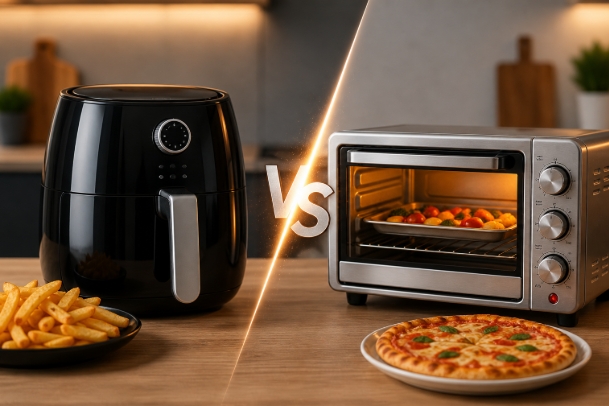
The difference between an air fryer and a toaster oven becomes easier to understand when you look at their design rather than simply counting their cooking functions.
An air fryer is generally built around rapid hot-air circulation and compact cooking. A toaster oven is built around a larger oven-style chamber and multiple cooking methods.
This difference affects everything from cooking speed and crispiness to capacity and versatility.
1. Cooking Technology
Air fryers are designed to move hot air rapidly around the food. Their compact chamber and powerful fan make them particularly effective at browning and crisping foods.
A traditional toaster oven relies more heavily on heat from its heating elements. A convection toaster oven adds a fan to circulate that heat.
This means a convection toaster oven can come surprisingly close to an air fryer in certain cooking situations.
For example, if you use a perforated air-fry tray in a convection toaster oven, hot air can circulate around French fries or chicken wings and produce a crispy result.
However, a dedicated basket-style air fryer is still specifically optimized for this type of cooking.
2. Cooking Chamber
The size and shape of the cooking chamber are major differences.
Most basket-style air fryers have a relatively compact vertical or drawer-style cooking area. This makes them efficient for small portions but can limit the size of food you can fit inside.
A toaster oven generally has a wider, flatter cooking chamber. This gives you more room for foods such as pizza, toast, sandwiches, baking trays, and larger cuts of food.
For example, a whole small pizza may fit comfortably in a toaster oven but may be difficult or impossible to fit into a compact basket air fryer.
3. Air Circulation
Air circulation is particularly important when comparing an air fryer vs convection toaster oven.
Both appliances can circulate hot air, but their designs are different.
A dedicated air fryer usually concentrates airflow around food in a small chamber. The basket allows air to reach multiple sides of the food.
A convection toaster oven has more space to heat and circulate air through. Its airflow can still be effective, especially when the appliance has a strong fan and an air-fry function, but the cooking experience may be different.
This is why two appliances with the same temperature setting can produce different results.
Setting both appliances to 200°C, for example, does not guarantee that the food will brown at exactly the same rate. Airflow, heating-element placement, food distance from the elements, and chamber design all influence the result.
4. Cooking Capacity
Capacity is another major consideration.
A small air fryer can be excellent for one or two people but may require multiple batches when cooking for a larger household.
Suppose you want to prepare enough chicken wings for six people. A small basket-style air fryer may require several cooking cycles. A larger toaster oven could potentially spread the wings over a larger tray and cook more food at once.
However, larger air fryers can reduce this gap. Dual-basket models, large-capacity air fryers, and oven-style air fryers provide considerably more cooking space than compact basket models.
So, do not judge capacity based solely on whether an appliance is called an “air fryer” or “toaster oven.” Check the actual usable cooking area and think about the types of food you normally prepare.
5. Cooking Speed
Air fryers generally have an advantage when preparing small portions.
Their compact cooking chambers heat quickly, and strong airflow helps transfer heat to the food efficiently.
A toaster oven can take longer to heat, particularly if it has a larger interior. However, the difference becomes less important when you are cooking a larger amount of food.
For example, cooking one serving of fries may be faster in an air fryer. But if you need to cook enough food for an entire family, using a larger toaster oven in one batch could be more convenient than running a small air fryer several times.
This is why air fryer vs toaster oven cooking time should always be considered alongside capacity.
Speed per batch is not necessarily the same thing as speed for the entire meal.
6. Versatility
This is where the toaster oven generally has the strongest advantage.
A basic air fryer is excellent at air frying, roasting, reheating, and cooking frozen foods. Some models also bake, broil, dehydrate, and perform other functions.
A toaster oven is naturally suited to a broader range of oven-style tasks.
It can be particularly useful for people who frequently switch between toast, baking, roasting, reheating, and broiling.
However, modern air-fryer toaster ovens have narrowed this difference considerably.
If you want one appliance that combines both approaches, an air-fryer toaster oven can be an attractive option. Just remember that the larger versatility often comes with a larger countertop footprint.
7. Ease of Use
Both appliances can be easy to use, but their controls and cooking processes differ.
An air fryer often involves selecting a temperature and cooking time, placing food in the basket, and occasionally shaking or turning it.
A toaster oven may require choosing a cooking function, adjusting the temperature, selecting a rack position, and deciding whether to use a tray or pan.
For someone who mostly wants to cook quick snacks or crispy foods, an air fryer may feel more straightforward.
For someone who already cooks with an oven, the toaster oven may feel more familiar.
8. Counter Space
Counter space can become an overlooked factor.
A compact air fryer may have a smaller footprint, although some large air fryers can be surprisingly bulky.
Toaster ovens generally require more horizontal counter space because of their wider cooking chambers and front-opening doors.
However, there is another side to the equation.
If a toaster oven replaces a toaster, small oven, and sometimes even an air fryer, its larger size may be worthwhile.
Therefore, when comparing appliances for a small kitchen, do not only ask, “Which appliance is smaller?”
Ask:
“Which appliance can replace the most other appliances without making my kitchen harder to use?”
That question often leads to a more practical buying decision.
Air Fryer vs Toaster Oven: Cooking Performance
When comparing an air fryer vs toaster oven, cooking performance is one of the most useful ways to decide which appliance deserves space on your countertop. Specifications such as wattage and capacity are helpful, but they do not always tell you how food will actually turn out.
The better appliance can change depending on what you are cooking. An air fryer tends to perform exceptionally well when food needs strong airflow and a crisp exterior. A toaster oven, particularly a convection model, is often more useful when you need more space or want to perform several different cooking tasks.
For example, imagine preparing dinner for two people. If you are making chicken wings and potato wedges, an air fryer can be an excellent choice because both foods benefit from rapid hot-air circulation. But if you are preparing a pizza, garlic bread, and a baked dish, the larger cooking area of a toaster oven may be more practical.
French Fries
French fries are one of the clearest examples of where an air fryer can have an advantage.
The basket design allows hot air to circulate around the fries, helping remove surface moisture and encourage browning. Frozen fries can become crisp on the outside while remaining tender inside without the need for deep frying.
For the best results, avoid filling the basket until the fries are packed tightly together. A crowded basket reduces airflow and can cause the fries to cook unevenly.
A toaster oven can also make good fries, especially if it has convection cooking or a dedicated air-fry function. A perforated tray can improve airflow underneath the fries and help them brown more evenly.
However, a basic toaster oven may require more cooking time and may not provide the same level of concentrated airflow as a dedicated air fryer.
Best for maximum crispiness: Air fryer.
Best for larger batches: Toaster oven.
Chicken Wings
Chicken wings are another food where the air fryer performs particularly well.
The strong circulation of hot air helps dry the surface of the chicken while the heat renders some of the fat in the skin. This combination can produce nicely browned and crisp skin without deep frying.
For example, if you are preparing a small batch of wings for two or three people, an air fryer can make the process quick and convenient.
A toaster oven can also produce excellent wings, especially when you have a larger batch. You can spread the wings across a tray instead of squeezing them into a small basket.
The important factor is airflow. Whether you use an air fryer or toaster oven, leaving enough space between pieces will generally give you better browning than piling everything together.
Best for small batches and crispiness: Air fryer.
Best for larger batches: Toaster oven.
Frozen Foods
Frozen foods are one of the easiest categories to cook in an air fryer.
Foods such as chicken nuggets, fish sticks, onion rings, spring rolls, potato bites, and frozen fries can often go directly from the freezer into the air fryer.
The rapid circulation of hot air helps the food heat through while producing a browned exterior.
A toaster oven can handle these foods too, and a convection model can perform particularly well. The main difference is often speed and airflow.
If you frequently prepare frozen snacks after work or need a quick lunch, the air fryer can be more convenient because you usually do not need to heat a large cooking chamber.
Best for quick frozen foods: Air fryer.
Pizza
Pizza is a more interesting comparison because the answer depends on whether you are cooking or reheating.
A toaster oven generally has the advantage when you want to heat several slices or cook a larger pizza. Its wider cooking chamber allows the pizza to sit flat on a rack or tray.
An air fryer is excellent for reheating one or two slices. The circulating heat can help restore some crispness to the crust without making the pizza as soft as it might become in a microwave.
For example, if you have one leftover slice from yesterday’s dinner, an air fryer can be a convenient choice. If you are preparing a full frozen pizza for several people, a toaster oven is usually more practical.
Best for individual slices: Air fryer.
Best for larger pizzas: Toaster oven.
Vegetables
Both appliances can roast vegetables effectively.
An air fryer is particularly good when you want vegetables with browned or slightly crispy edges. Foods such as broccoli, cauliflower, carrots, Brussels sprouts, and potato chunks can develop good surface browning when they are spread out properly.
A toaster oven provides more space, which can be useful when preparing a large tray of vegetables for a family meal.
The choice therefore comes down to portion size and desired texture.
If you are roasting a small amount for one or two people, an air fryer may be quicker. If you are preparing vegetables as part of a larger family dinner, the toaster oven may be more convenient.
Best for small portions: Air fryer.
Best for larger portions: Toaster oven.
Baking
Baking is one area where the toaster oven generally has an advantage.
Its wider and more oven-like cooking chamber gives you room for baking trays, pans, cookies, pastries, and other foods that need a flat surface.
An air fryer can certainly bake. Many models have dedicated bake settings, and some include accessories designed for cakes, bread, or other baked foods.
The limitation is usually space.
If you only bake small portions occasionally, an air fryer may be sufficient. But if baking is an important part of your cooking routine, a toaster oven will generally be more convenient.
Best for regular baking: Toaster oven.
Air Fryer vs Toaster Oven: Which Cooks Faster?
When people search for air fryer vs toaster oven cooking time, they are usually looking for a simple answer: which appliance gets dinner on the table faster?
In most cases, an air fryer has an advantage when cooking small portions.
The reason is straightforward. An air fryer usually has a compact chamber, so there is less space to heat. Its fan also moves hot air rapidly around the food.
A toaster oven has a larger cavity, which can take longer to heat, particularly when preheating is required.
However, cooking speed should not be judged only by how quickly one batch finishes.
Imagine you need to cook enough fries for six people. A small air fryer might finish one batch quickly but require several rounds. A large toaster oven might take longer to heat but allow you to cook the entire quantity at once.
In that situation, the toaster oven could actually be more convenient overall.
What Affects Cooking Time?
Several factors influence how quickly either appliance cooks food:
- Food type
- Portion size
- Appliance wattage
- Starting temperature
- Cooking temperature
- Preheating
- Air circulation
- Basket or tray arrangement
- Number of batches
For instance, frozen food generally cooks differently from fresh food because it begins at a much lower temperature.
Similarly, a crowded air fryer basket can take longer to cook food evenly because the hot air cannot circulate properly.
Do Air Fryers Always Need Preheating?
Not necessarily.
Some air fryer recipes benefit from preheating because starting with a hot cooking chamber can improve browning and make cooking times more predictable.
However, many foods can be cooked successfully without a separate preheating step.
The same principle applies to toaster ovens. Some recipes call for preheating, while others can start in a cold oven.
Always follow the instructions for your particular appliance and recipe rather than assuming every air fryer or toaster oven behaves the same way.
Which Makes Food Crispier: Air Fryer or Toaster Oven?
If crispiness is your top priority, an air fryer generally has the advantage.
This comes down mainly to airflow and cooking chamber design.
A dedicated air fryer is built to move hot air rapidly around food in a relatively compact space. This helps remove moisture from the surface while encouraging browning.
That is particularly useful for foods such as French fries, chicken wings, potato wedges, and breaded frozen foods.
A toaster oven can still produce crispy food, especially when it uses convection or has an air-fry function. However, a standard toaster oven without strong air circulation may not produce the same results as quickly.
Why Does Airflow Matter?
Think about two pieces of chicken.
If one piece is exposed to moving hot air, moisture on the surface can evaporate more effectively. If another piece is surrounded by other food with little airflow, the moisture may remain trapped around the surface.
That is why overcrowding is a problem in both appliances.
The goal is to give hot air enough room to reach the food.
For particularly crispy results, you can also lightly coat certain foods with oil. Oil is not always necessary, but a small amount can help with browning and texture.
Overall winner for crispiness: Air fryer.
Air Fryer vs Toaster Oven: Which Uses Less Electricity?
The question of air fryer vs toaster oven electricity use is more complicated than comparing the wattage printed on the appliance.
Wattage tells you how much electrical power an appliance can draw while operating. It does not tell you exactly how much electricity it will consume for a particular meal.
Cooking time matters too.
For example, an air fryer may have a relatively high power rating but cook a small portion in a short period. A toaster oven may have a similar or higher rating but run for longer because it takes more time to heat and cook the food.
At the same time, a toaster oven can sometimes be more efficient for larger meals because it allows you to cook more food in one batch.
Wattage vs Actual Energy Consumption
When comparing energy consumption, consider:
- Wattage
- Cooking duration
- Preheating time
- Food quantity
- Number of batches
- Cooking temperature
- Appliance efficiency
A simple example helps.
Suppose you are preparing a small serving of frozen fries. An air fryer may heat quickly and finish the food without requiring much cooking time.
Now imagine preparing several servings for a family. If your small air fryer requires three or four batches, the total operating time increases.
A larger toaster oven could potentially cook the entire amount in one batch.
This is why it is difficult to say that an air fryer always uses less electricity than a toaster oven.
Which Is More Energy Efficient?
For small portions, an air fryer often makes practical sense because its compact cooking chamber can heat quickly.
For larger quantities, a toaster oven may be more practical if it allows you to cook everything at once.
The most useful question is therefore not simply:
“Which appliance has the lower wattage?”
Instead, ask:
“Which appliance can cook the amount of food I need without unnecessary cooking time or extra batches?”
That gives you a much more realistic view of energy use.
Air Fryer vs Toaster Oven for Baking
When comparing an air fryer vs toaster oven for baking, the toaster oven usually comes out ahead.
The main reason is the cooking space.
Baking often requires a flat, stable surface and enough room for the food to expand. A toaster oven provides a rack or tray that can accommodate baking pans more naturally.
For example, if you want to bake a small batch of cookies, a toaster oven allows you to place several cookies on a tray with enough space between them.
An air fryer can bake cookies too, but the smaller basket may limit the number you can prepare at one time.
The same applies to bread, pastries, cakes, and other baked foods.
Can You Bake in an Air Fryer?
Yes.
Many air fryers have bake settings, and some include accessories specifically designed for baking.
They can work well for small cakes, muffins, cookies, and other recipes that fit comfortably inside the cooking chamber.
However, the cooking environment is different from a traditional oven.
Because the air moves rapidly around the food, the surface may brown faster than expected. You may need to adjust the cooking temperature or time depending on the recipe.
If you are adapting a conventional oven recipe for an air fryer, it is wise to monitor the food closely the first time rather than assuming the original cooking time will be perfect.
Best for regular baking: Toaster oven.
Best for occasional small-batch baking: Air fryer.
Air Fryer vs Toaster Oven for Reheating Food
Both appliances are excellent for reheating food, but the best choice depends on the texture you want.
A microwave is usually faster for simply warming food, but it can make crispy foods soft. This is where an air fryer or toaster oven becomes useful.
An air fryer is particularly good at reheating foods where you want to restore some of the original crispness.
Examples include:
- French fries
- Fried chicken
- Chicken wings
- Spring rolls
- Breaded fish
- Pizza crust
- Potato wedges
The circulating hot air helps warm the food while drying the surface.
A toaster oven can achieve a similar result and may be better when you need to reheat a larger quantity.
For example, four or five slices of pizza can be easier to arrange in a toaster oven than in a small air fryer basket.
Best for crispy leftovers: Air fryer.
Best for larger portions: Toaster oven.
Air Fryer vs Toaster Oven for Toast
When it comes to traditional toast, the toaster oven has a clear advantage.
Toaster ovens are designed around a wide cooking chamber that makes it easy to place bread directly on a rack.
You can toast bread, bagels, English muffins, sandwiches, and similar foods without trying to fit them into a small basket.
An air fryer can brown bread, but it is not usually as convenient for everyday toast.
For example, if breakfast normally includes two slices of toast every morning, a toaster oven may be more practical.
This is one of those situations where an appliance’s most important feature is not necessarily its most advanced technology. Sometimes the best appliance is simply the one that makes your regular routine easier.
Winner for traditional toast: Toaster oven.
Air Fryer vs Toaster Oven for Small Kitchens
Counter space is an important consideration, especially if your kitchen is already crowded with appliances.
A compact air fryer can be easier to fit into a small kitchen because many models have a relatively small footprint.
However, size alone should not determine your decision.
Some large air fryers can take up significant counter space, while some compact toaster ovens can be surprisingly efficient with their footprint.
You also need to consider clearance and usability. An appliance may physically fit on your counter but still be inconvenient if you cannot open its door or remove its basket comfortably.
Which Is Better for an Apartment?
For a small apartment kitchen, an air fryer can be a strong choice if your meals are mainly quick and crispy foods.
For example, someone who regularly cooks frozen foods, chicken, vegetables, fries, and small portions may appreciate the compact cooking process.
But a toaster oven may provide more value if you want one appliance to perform several jobs.
Instead of keeping a separate toaster, small oven, and possibly another appliance for reheating, a multifunction toaster oven can handle many of those tasks.
Therefore, the better choice for a small kitchen depends on what you need the appliance to replace.
Air Fryer vs Toaster Oven for a Family
For families, capacity becomes much more important than it is for someone cooking for one or two people.
A small air fryer may be convenient but can become frustrating if you constantly have to prepare several batches.
For example, imagine preparing chicken nuggets and fries for a family of five. A compact basket may require multiple cooking cycles.
A larger air fryer can reduce this problem, and dual-basket models can be particularly useful when you want to cook different foods at the same time.
A toaster oven can also be a strong family option because its larger cooking chamber allows you to spread food across a tray.
However, the best option depends on the specific model rather than the appliance category alone.
Before buying, check the usable cooking area and consider the actual foods you prepare. Advertised quart or liter capacity does not always tell you how much usable horizontal cooking space you have.
For maximum flexibility with larger foods: Toaster oven.
For crispy foods and separate cooking zones: Larger or dual-basket air fryer.
Air Fryer vs Toaster Oven: Which Is Easier to Clean?
Cleaning is easy to overlook when comparing countertop appliances. Most people focus on cooking performance, capacity, and features when shopping, but the appliance that is easier to clean is often the one you will enjoy using more regularly.
Both an air fryer and toaster oven need routine cleaning. Food particles, grease, crumbs, and cooking residue can accumulate over time, especially when you regularly cook fatty foods or foods that splatter.
The main difference is the design of the cooking area.
Cleaning an Air Fryer
Most basket-style air fryers have a removable cooking basket and a tray or crisper plate. This makes routine cleaning relatively straightforward because you can remove the parts that come into direct contact with food.
After cooking chicken wings, for example, you may have grease and small food particles left in the basket. Allowing the basket to cool before cleaning can make the process easier and safer.
Some models have dishwasher-safe components, although you should always check the manufacturer’s instructions before putting removable parts into a dishwasher.
Even when the basket is dishwasher-safe, it is still a good idea to wipe away grease and food residue regularly. Small amounts of buildup can become harder to remove if they are repeatedly exposed to high heat.
The heating chamber also needs occasional attention. Crumbs and grease can collect around the heating element or fan area, so the interior should be checked and cleaned according to the manufacturer’s instructions.
Cleaning a Toaster Oven
Toaster ovens generally require more attention because they have more internal surfaces and components.
Depending on the model, you may need to clean:
- Cooking racks
- Baking trays
- Crumb trays
- Interior walls
- Door glass
- Air-fry baskets
The crumb tray is particularly useful because it catches loose food particles. Emptying it regularly prevents crumbs from accumulating and potentially burning during later cooking cycles.
If you regularly bake or roast greasy foods, you may also notice residue on the walls or around the cooking chamber.
Unlike a removable air fryer basket, the interior of a toaster oven cannot simply be taken to the sink. Cleaning therefore requires a little more care.
Which Is Easier to Maintain?
For quick everyday cleaning, a basket-style air fryer usually has the advantage.
The removable basket and compact cooking chamber make routine cleanup relatively simple.
A toaster oven can take more time because of its racks, trays, crumb tray, and larger interior.
However, cleaning convenience varies by model. A toaster oven with removable, dishwasher-safe accessories can be easier to maintain than a poorly designed air fryer basket that traps grease around its edges.
Best for simple everyday cleaning: Air fryer.
Air Fryer vs Toaster Oven: Which Is More Versatile?
Versatility is one of the strongest arguments in favor of a toaster oven.
A basic air fryer is primarily designed for air frying, roasting, reheating, and similar high-heat cooking tasks. Modern models can offer additional functions such as baking, broiling, dehydrating, and even cooking multiple foods at once.
A toaster oven, however, starts with a more traditional oven-style design.
It can usually toast, bake, broil, roast, and reheat. Convection models add air circulation, while air-fryer toaster ovens add another layer of functionality.
This means a toaster oven can potentially replace several countertop appliances.
For example, instead of having a separate toaster for bread and an air fryer for crispy foods, you could use a multifunction toaster oven for both tasks.
That does not automatically make the toaster oven the better purchase. If you rarely toast or bake and mostly want fast crispy food, many of those extra functions may go unused.
The most useful appliance is the one whose features you will actually use.
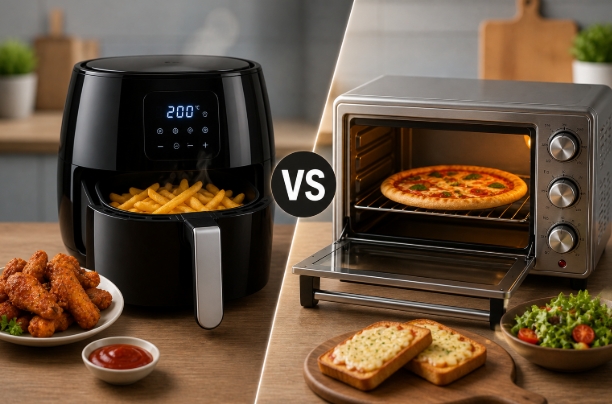
What About an Air-Fryer Toaster Oven?
An air-fryer toaster oven attempts to combine the strengths of both appliances.
It generally has:
- A larger oven-style cooking chamber
- Toasting functions
- Baking functions
- Broiling
- Convection cooking
- An air-fry mode
- A perforated air-fry tray or basket
This can be an attractive option if you want one appliance for several different cooking tasks.
However, there is a trade-off.
An air-fryer toaster oven is usually larger than a compact basket air fryer. It may also take longer to heat because its cooking chamber is larger.
So while it can provide greater versatility, it may not deliver exactly the same convenience as a dedicated air fryer for every small, quick meal.
Air Fryer Pros and Cons
Understanding the strengths and weaknesses of an air fryer can make the buying decision much easier.
Pros of an Air Fryer
Fast Cooking
Air fryers are generally quick, particularly when cooking smaller portions.
Their compact chamber and rapid airflow can help food heat and brown efficiently.
Excellent Crispiness
If you enjoy crispy fries, chicken wings, potato wedges, and breaded foods, an air fryer is hard to beat.
Its airflow-focused design is one of its biggest strengths.
Great for Frozen Foods
An air fryer is convenient when you want to cook frozen foods without using a full-size oven.
This can be particularly useful for quick lunches, snacks, or after-work meals.
Convenient for Small Portions
You do not need to heat a large oven when preparing a small amount of food.
For one or two people, this can make everyday cooking simpler.
Usually Easy to Use
Many air fryers have simple digital controls, preset programs, or straightforward temperature and time settings.
Even manual models can be easy to operate once you understand the basic cooking process.
Good for Reheating Crispy Foods
An air fryer can restore some of the texture that gets lost when fried foods are refrigerated.
Instead of reheating fries until they become soft, you can use circulating hot air to warm and crisp them.
Cons of an Air Fryer
Limited Capacity on Smaller Models
A compact air fryer can become inconvenient when you need to cook for several people.
You may need multiple batches, especially for foods that need to be spread out in a single layer.
Basket Space Can Be Restrictive
Some foods simply do not fit comfortably into a basket.
Large pizzas, long sandwiches, and larger baking dishes can be difficult or impossible to accommodate.
Not Ideal for Traditional Toast
Although you can brown bread in an air fryer, it is not the most convenient appliance for everyday toast.
Overcrowding Can Reduce Performance
Putting too much food in the basket can block airflow and lead to uneven cooking.
This means the advertised capacity is not always the same as the ideal capacity for crispy results.
Toaster Oven Pros and Cons
A toaster oven has a different set of strengths.
Pros of a Toaster Oven
Excellent Versatility
A toaster oven can handle many cooking methods from one countertop appliance.
Depending on the model, you can toast, bake, broil, roast, reheat, and air fry.
Better for Baking
The larger cooking chamber makes baking more convenient.
You can use trays and pans that would not fit inside many basket-style air fryers.
More Room for Larger Foods
A toaster oven can accommodate foods such as pizza, sandwiches, larger portions of vegetables, and some cuts of meat.
Excellent for Toast
This is one of its obvious strengths.
If toast, bagels, and similar foods are part of your regular breakfast routine, a toaster oven can be much more convenient than an air fryer.
Can Replace Several Appliances
A multifunction toaster oven may replace a basic toaster and provide some of the functions of a conventional oven and air fryer.
This can be useful when counter space is limited and you prefer fewer appliances.
Cons of a Toaster Oven
Larger Countertop Footprint
The wider cooking chamber means toaster ovens generally require more counter space.
This can be a problem in smaller kitchens.
Can Take Longer for Small Portions
Heating a larger chamber just to cook a small amount of food may not always be as convenient as using a compact air fryer.
Standard Models May Not Crisp Food as Well
A basic toaster oven without strong convection may not produce the same level of crispiness as a dedicated air fryer.
Cleaning Can Take More Effort
Racks, trays, crumb trays, and the larger interior all require maintenance.
Is an Air Fryer Better Than a Toaster Oven?
An air fryer is better if your priority is fast, crispy cooking.
It is particularly useful for people who frequently prepare:
- French fries
- Chicken wings
- Frozen snacks
- Potato wedges
- Breaded foods
- Roasted vegetables
- Crispy leftovers
The compact design also makes it attractive for people who normally cook smaller portions.
However, that does not mean an air fryer is the better appliance for everyone.
If you regularly bake, toast bread, cook pizza, or prepare larger meals, the limitations of a small basket can become frustrating.
A toaster oven may then provide more practical value.
So, when asking which is better, air fryer or toaster oven, think about your normal cooking routine rather than the appliance that has the most impressive marketing claims.
Can a Toaster Oven Replace an Air Fryer?
Yes, but there is an important condition.
A toaster oven can replace an air fryer more effectively when it has convection cooking and a dedicated air-fry function.
An air-fry setting typically changes how the appliance circulates hot air and may use a perforated tray to allow more airflow around the food.
For example, if you want to cook frozen fries, placing them on an air-fry tray allows hot air to reach more of their surface than a solid baking tray would.
This can produce results that are much closer to those of a dedicated air fryer.
When a Toaster Oven Is a Good Air Fryer Replacement
A toaster oven may be a good replacement if you:
- Want one multifunction appliance
- Have enough counter space
- Regularly bake and toast
- Cook larger portions
- Still want the option to air fry
When a Dedicated Air Fryer May Be Better
A separate air fryer may still be preferable if you:
- Prioritize maximum crispiness
- Mostly cook small portions
- Want faster cooking
- Frequently prepare fries and wings
- Prefer a compact basket design
Can an Air Fryer Replace a Toaster Oven?
An air fryer can replace a toaster oven for some households, but there are limitations.
If your toaster oven is mainly used for reheating leftovers, roasting vegetables, and cooking frozen foods, an air fryer may cover most of those tasks.
However, if you use your toaster oven for toast, bagels, baking, pizza, sandwiches, and larger foods, an air fryer may not provide the same convenience.
For example, you can reheat one slice of pizza easily in an air fryer. But if you regularly need to reheat several slices at once, the basket may not provide enough room.
Likewise, an air fryer can bake small cookies or cakes, but the cooking space may limit the size of the batch.
Therefore, an air fryer can replace a toaster oven for some cooking styles, but it is not a complete replacement for everyone.
Air Fryer vs Convection Toaster Oven: Which Should You Choose?
The comparison becomes closer when the toaster oven uses convection.
Both appliances circulate hot air, so they can produce similar results for certain foods.
The main difference is still the cooking environment.
A dedicated air fryer generally provides a compact chamber with strong airflow around the food.
A convection toaster oven gives you more cooking space while still circulating heated air.
Choose an Air Fryer If:
- You mainly cook small portions
- Crispiness is your priority
- You want quick cooking
- You frequently cook fries or wings
- You want a compact appliance
Choose a Convection Toaster Oven If:
- You want more cooking space
- You bake regularly
- You toast frequently
- You cook pizza or larger foods
- You want multiple cooking functions
Choose an Air-Fryer Toaster Oven If:
- You want both cooking styles
- You have enough counter space
- You want one multipurpose appliance
- You regularly air fry and bake
Air Fryer vs Toaster Oven: Which One Should You Buy?
There is no single winner for every household.
The right choice depends on what you expect from the appliance.
Choose an Air Fryer If You:
Choose an air fryer if your cooking mainly revolves around speed and crispiness.
It makes particularly good sense if you frequently prepare fries, wings, frozen foods, roasted vegetables, and small meals.
It is also a strong choice if you live alone or cook for two people and do not need a large cooking chamber.
If you have limited counter space, a compact model can also be easier to accommodate.
Choose a Toaster Oven If You:
A toaster oven is usually the better option if you want versatility.
Choose one if you regularly:
- Toast bread
- Bake
- Reheat pizza
- Roast food
- Prepare sandwiches
- Cook larger portions
- Use oven-style trays
A convection model becomes even more attractive if you want faster cooking and improved air circulation.
Choose an Air-Fryer Toaster Oven If You:
An air-fryer toaster oven can be the middle ground.
It may be a good option if you want:
- Air frying
- Toasting
- Baking
- Broiling
- Roasting
- Reheating
- More cooking space
The main trade-off is size.
You should measure your countertop before buying and make sure there is adequate clearance around the appliance according to the manufacturer’s instructions.
Frequently Asked Questions
Is an air fryer better than a toaster oven?
An air fryer is generally better for fast cooking and crispy foods, while a toaster oven is usually better for versatility, baking, toasting, and larger portions. Neither is universally better because the right choice depends on how you cook.
What is the main difference between an air fryer and a toaster oven?
An air fryer typically uses a compact cooking chamber and strong hot-air circulation to cook food quickly and crisp its surface. A toaster oven uses heating elements in a larger oven-style chamber and may add convection airflow.
Does an air fryer use less electricity than a toaster oven?
Not always. An air fryer can be efficient for small portions because it heats a smaller chamber and often cooks quickly. A toaster oven can make more sense for larger meals because it may cook a greater quantity in one batch. Wattage, cooking time, preheating, and batch size all affect electricity consumption.
Is an air fryer faster than a toaster oven?
An air fryer is generally faster for small portions because of its compact cooking chamber and rapid airflow. However, a toaster oven may be more efficient for larger quantities because it can cook more food at once.
Can a toaster oven replace an air fryer?
Yes, particularly if the toaster oven has convection and a dedicated air-fry function. It can handle many of the same foods, although a dedicated air fryer may still provide stronger airflow and faster crisping for small portions.
Conclusion
So, air fryer vs toaster oven—which is better?
For fast cooking and maximum crispiness, a dedicated air fryer generally has the advantage. Its compact cooking chamber and strong hot-air circulation make it particularly effective for foods such as French fries, chicken wings, frozen snacks, potato wedges, and crispy leftovers.
For versatility, baking, toasting, and larger portions, a toaster oven is usually the stronger choice. Its larger cooking chamber makes it easier to prepare pizza, toast, baked foods, sandwiches, and meals that need more horizontal space.
A convection toaster oven with an air-fry function can narrow the difference considerably. It may be the best option for someone who wants the flexibility of a toaster oven without giving up the ability to cook crispy foods.
Ultimately, there is no need to choose based on which appliance is considered universally superior. Think about what you actually cook.
If most of your meals are quick, crispy foods for one or two people, an air fryer is likely to give you more practical value.
If you want one appliance that can handle toast, baking, roasting, reheating, pizza, and air frying, a toaster oven may be the more versatile investment.
And if you want both capabilities and have enough counter space, an air-fryer toaster oven can offer a useful compromise.
The best appliance is therefore the one that fits your cooking habits, household size, available space, preferred foods, and budget.